

By Staff Writer
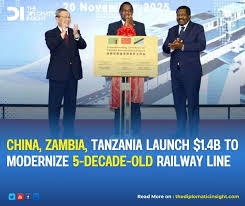
The Chinese Premier Li Qiang alongside Zambian president Hakainde Hichilema and Tanzania Vice President Emmanuel Nchimbi attended ground breaking ceremony fot TAZARA revitalization in Lusaka-Zambia on November 20, 2025(Xinhua)
China–Africa cooperation is entering a significant new phase as revitalization efforts begin on the historic Tanzania–Zambia Railway Authority (TAZARA) line. Chinese premier was in Zambia on 20th November 2025, for a breaking ground ceremony to revitalize TAZARA railway. The Chinese premier stood along Zambian president Hakainde Hichilema and Tanzania Vice President Emmanuel Nchimbi, symbolizing the tripartite cooperation framework of TAZARA railway project.
Long celebrated as a symbol of solidarity and shared struggle, the railway is once again at the center of China–Africa relations—this time as a driver of modernization and economic transformation. Chinese Premier Li’s recent remarks underscore this renewed commitment, noting that China–Africa cooperation has embarked on “a new journey toward the shared dream of modernization,” and identifying TAZARA as a landmark project whose rejuvenation carries deep historical and strategic meaning.
Constructed in the 1970s with Chinese financing, engineering, and labor, TAZARA was a bold response to political and economic realities. Zambia, then landlocked and heavily dependent on routes controlled by colonial or minority-ruled governments, sought an independent transport lifeline to the sea. The result was not only a functional rail corridor stretching from Kapiri Mposhi in Zambia to the port of Dar es Salaam in Tanzania, but also a symbol of friendship forged under challenging circumstances.
More than 50 years later, that spirit of partnership is being renewed. Economic landscapes have changed considerably; Africa’s industrial ambitions and China’s global development outreach now intersect in new, more expansive ways. Modernization of the TAZARA railway is therefore more than a rehabilitative project—it is a strategic investment in Africa’s future connectivity, trade capacity, and industrial growth.
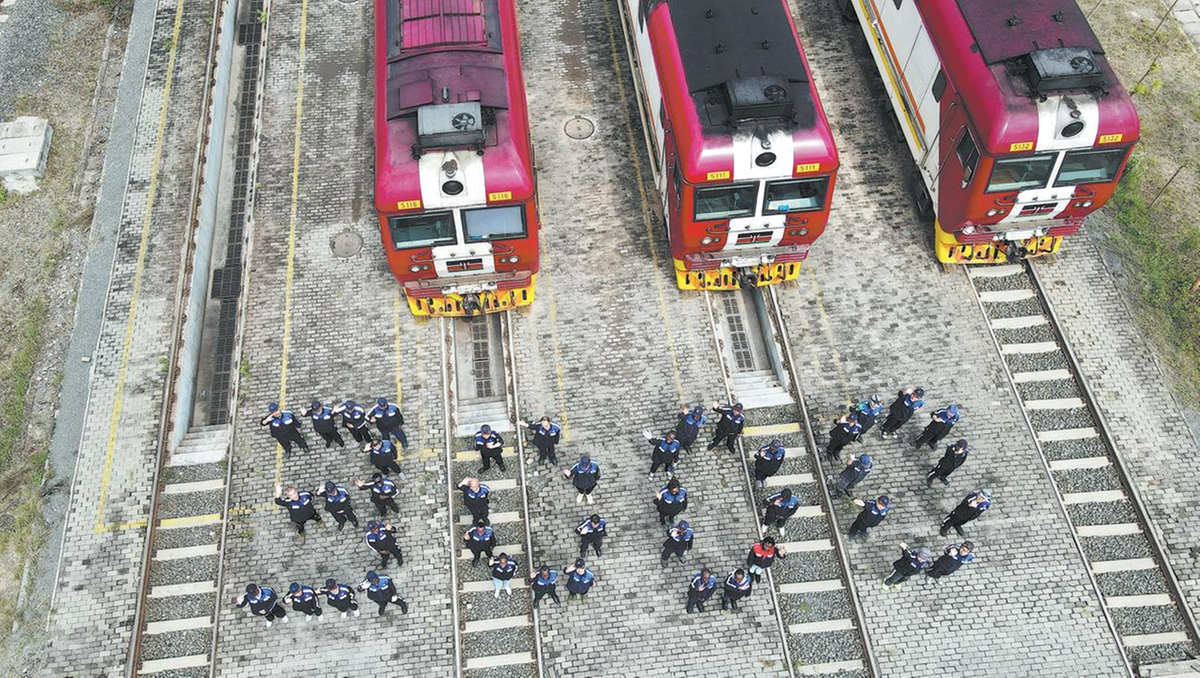
The revitalization effort aims to make TAZARA more efficient, reliable, and commercially competitive. Upgrades are expected across multiple fronts: track rehabilitation to increase train speeds, modernization of signaling and communication systems, acquisition of new locomotives and rolling stock, and improvements in management and operations. These advancements will help transform TAZARA from an aging symbolic asset into a modern logistics artery capable of moving larger volumes of goods at reduced costs and shorter transit times.
For Tanzania and Zambia, the implications are far-reaching. A more efficient TAZARA line means enhanced trade flows, improved access to global markets, and greater support for regional industrialization. As both countries pursue ambitious economic diversification agendas—particularly in mining, agriculture, and manufacturing—the railway stands to play a central role in unlocking new economic zones, connecting rural producers to urban markets, and attracting foreign investment.
A revitalized TAZARA corridor can strengthen the Southern African Development Community (SADC) transport network by easing pressure on crowded road systems and linking inland economies more effectively to Tanzania’s Indian Ocean coastline. This positions TAZARA as a critical component of Africa’s broader infrastructure integration goals under the African Continental Free Trade Area (AfCFTA), facilitating smoother movement of goods across borders.
China’s renewed involvement in TAZARA also reflects a broader evolution in China–Africa cooperation. No longer limited to infrastructure construction, the partnership now emphasizes modernization, sustainability, skills transfer, and long-term economic impact. Chinese Premier Li’s statements highlight a vision in which China and Africa pursue development side by side, supporting each other in transforming their economies and improving living standards.
Importantly, the revitalization project aligns with Africa’s own priorities. Many African leaders have emphasized the importance of high-quality infrastructure that boosts productivity, facilitates trade, and supports homegrown industrial capacity. China’s role—as financier, technology partner, and long-term collaborator—is welcomed in this context, especially when focused on upgrading existing assets rather than creating new debt burdens.
As TAZARA enters its new chapter, the railway once again becomes a living testament to China–Africa friendship. But more importantly, it becomes a practical, forward-looking instrument for shared development. The modernization of this historic line signals a deepened partnership rooted in mutual respect and common aspirations—a partnership now oriented toward building a more connected, modern, and prosperous future for Africa.
With the revitalization underway, TAZARA is poised to fulfill both its symbolic legacy and its economic potential, carrying the hopes of a new era of China–Africa cooperation along its tracks.