

By Staff writer
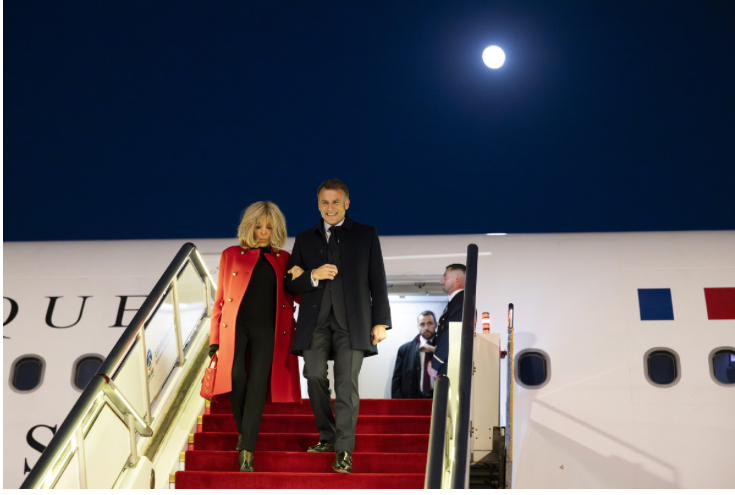
French President Emmanuel Macron arrives in Beijing, capital of China, Dec 3, 2025. [Photo/Xinhua]
French President Emmanuel Macron arrived in Beijing on Wednesday, for a three day state visit Wednesday for a state visit. He was welcomed by welcomed by Chinese Foreign Minister Wang Yi.
Macron’s visit to China comes at a critical moment for Europe, China, and the wider international community. As global tensions rise, economies adapt to new structural realities, and major powers reconsider their alignments, the visit carries political and strategic importance far beyond bilateral cooperation. For France, the trip represents an attempt to shape Europe’s role in world affairs, review trade relations, and enhance diplomatic engagement—including on the Russia–Ukraine war, one of the most consequential conflicts of the decade.
Economic cooperation is expected to be top on the agenda, as well as strengthening diplomatic ties. The two countries have copperated in various fields including, energy, agriculture, research, aviation, and cultural exchange. In 2025, both nations are looking to expand collaboration into new industries such as green technology, renewable energy, sustainable manufacturing, and electric mobility. Macron isaccompanied by business executives and policy specialists who aim to secure agreements that reflect mutual interests, particularly in environmentally oriented development.
Trade imbalance is another pressing issue shaping the visit. France, like several European states, has experienced a widening deficit in its trade with China. Macron hopes to negotiate greater market access for French companies, promote more reciprocal investment conditions, and address structural barriers that disadvantage European firms. While achieving significant rebalancing will be challenging, the visit sends a clear message: France favors constructive engagement rather than economic decoupling, but it seeks a fairer framework for cooperation.
A central geopolitical component of Macron’s visit revolves around the Russia–Ukraine war. As the conflict continues to destabilize Europe and strain global supply chains, France views China as a crucial stakeholder. Macron’s government believes that China, with political and economic ties to Russia, possesses influence that could help shape Moscow’s stand. Macron aims to communicate that a prolonged war threatens not only European security but also global economic stability, including interests shared by China.
Macron’s approach reflects a European perspective that isolating China will not produce outcomes beneficial to Kyiv or to European security; instead, dialogue remains one of the few channels through which gradual progress might be achieved.
The visit also fits into Macron’s broader vision of European strategic autonomy. France seeks a role for Europe that is neither subordinate to U.S. policy nor passively reactive to China’s global ascent. By engaging Beijing directly, Macron signals that Europe intends to shape its own relations with major powers in ways that reflect European priorities and values. With France set to host the G7 summit in 2026 and China leading APEC the same year, strong lines of communication may prove valuable for navigating global challenges. Macron’s trip illustrates a belief that sustained engagement—even when outcomes are uncertain—is essential in a world shaped increasingly by competition, interdependence, and shifting alliances.
In this sense, the significance of the visit extends beyond immediate agreements. It reflects France’s determination to remain a proactive diplomatic actor and Europe’s recognition that resolving global crises—from climate change to war—requires cooperation among all major powers, including China.