
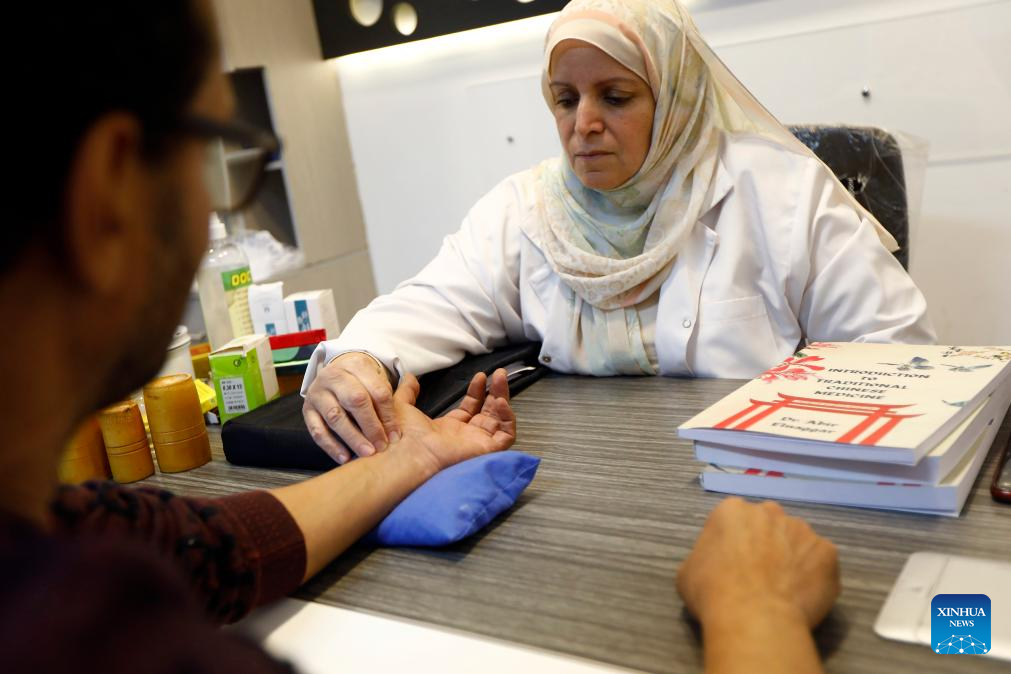
Egyptian physiotherapist and acupuncturist Abir El-Naggar feels the pulse of a man at a clinic in Cairo, Egypt, Nov. 30, 2025. (Xinhua/Ahmed Gomaa)
For centuries, traditional medicine has been an integral part of African societies, shaping healing practices, community well-being, and cultural identity. Across the continent, healers have utilized an extraordinary variety of plants, herbs, and natural compounds—many of which form the biochemical foundations of today’s modern pharmaceuticals. Yet despite this rich heritage and abundant biodiversity, Africa’s traditional medicine sector has not developed into a globally recognized, well-structured system. A significant part of this stagnation can be traced back to colonial legacies that labeled African healing knowledge as primitive or unscientific.
Colonial administrations systematically undermined indigenous medical systems. Missionary hospitals and European-trained doctors dismissed traditional healers as “witchdoctors” and their practices as superstition. This framing created a long-lasting stigma, causing post-colonial governments and local elites to distance themselves from indigenous knowledge. Instead of investing in research, documentation, and scientific validation of local remedies, many African states adopted Western medical systems wholesale, leaving traditional medicine largely informal and underfunded. The result was a missed opportunity: while Africa holds nearly 25% of the world’s medicinal plant biodiversity, it has struggled to convert this natural wealth into structured healthcare innovations or economically competitive pharmaceutics.
China, meanwhile, pursued a very different path. Traditional Chinese Medicine (TCM) was once viewed by some Western observers with the same skepticism directed at African medicine. But China refused to abandon its heritage. Instead, it invested strategically: establishing dedicated research institutes, integrating TCM into national healthcare, standardizing practices, and funding universities that train accredited practitioners. Today, TCM is a multi-billion-dollar global industry, exported worldwide, and recognized by the World Health Organization. It coexists—sometimes seamlessly—with modern biomedicine, showing that traditional systems can be both culturally relevant and scientifically grounded.
Africa can learn from this model. The first lesson is institutional support. China’s government-backed approach allowed TCM to evolve under rigorous scientific scrutiny. Africa, too, needs national and continental frameworks that fund research into medicinal plants, support clinical trials, and codify traditional knowledge in ways that protect it from exploitation. Strengthening intellectual property rights for indigenous healers and communities would ensure that knowledge is preserved and benefits are shared fairly.
Second, China demonstrates the importance of integrating traditional medicine into mainstream healthcare. In many African countries, traditional healers operate without regulation, training standards, or formal recognition. Instead of sidelining them, governments can develop certification systems, incorporate vetted remedies into public hospitals, and create partnerships between biomedical and traditional practitioners. This would not only expand healthcare access but also build public confidence.
Third, Africa must embrace self-reliance and innovation. The COVID-19 pandemic was a stark reminder of the continent’s vulnerability: no African country produced the life-saving vaccines during the crisis, leaving populations dependent on global charity, geopolitics, and inconsistent supply chains. This dependence highlighted the urgent need for Africa to invest not only in pharmaceutical manufacturing but also in its indigenous medical resources, which could complement modern treatments and help address local diseases with local solutions.
Some African countries have already taken promising steps. Madagascar’s herbal COVID-19 remedy, Ghana’s Centre for Plant Medicine Research, and Nigeria’s renewed interest in phytomedicine show growing momentum. But these efforts remain isolated and often lack the scale or continuity needed to rival global competitors.
For Africa to unlock the full potential of its traditional medicine, it must overcome historical inferiority narratives and invest confidently in homegrown knowledge. By studying China’s successful modernization of its traditional systems, Africa can craft a model that blends scientific rigor with cultural authenticity. The continent’s vast biodiversity, coupled with renewed political will and strategic investment, could transform African traditional medicine into a pillar of global health innovation.
Africa has the knowledge, the plants, and the history. What remains is the confidence—and the commitment—to turn its natural and cultural wealth into a source of healing, pride, and self-reliance.