



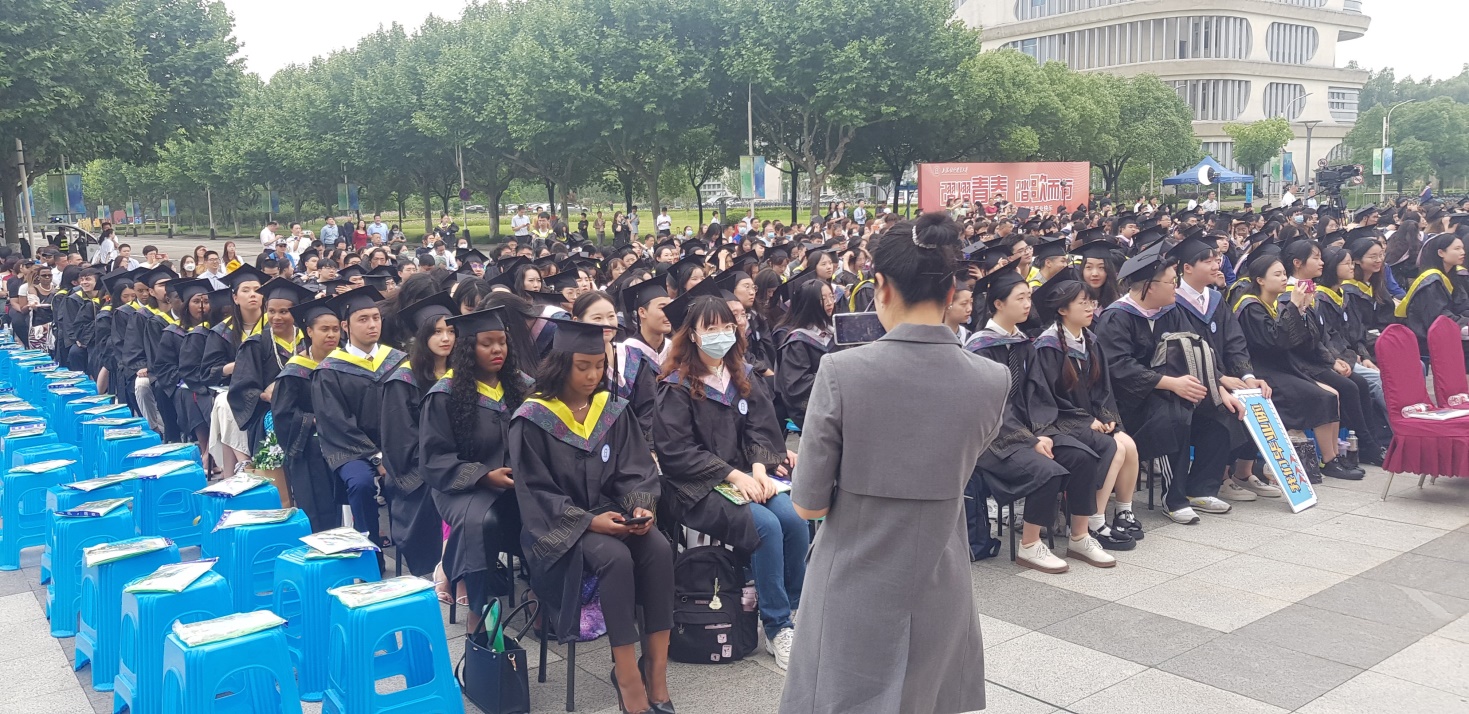
African students among the graduating students at Shanghai University of Business and Economics (2023). Photo credit: @Gerald Mbanda
By Gerald Mbanda
The decision to designate 2026 as the Year of People-to-People Exchanges between China and Africa reflects a growing recognition that the strength of China–Africa relations depends not only on governments and markets, but also on the relationships between ordinary citizens. After decades of cooperation driven largely by trade, infrastructure, and development finance, both sides are placing renewed emphasis on human connection as a foundation for long-term partnership.
People-to-people exchanges refer to structured and informal interactions among individuals and social institutions rather than official diplomatic engagements. In the China–Africa context, this includes education, culture, tourism, youth cooperation, academic research, media collaboration, and exchanges between local communities. The 2026 initiative seeks to scale up these interactions and give them clearer visibility and policy support.
One of the most immediate areas of impact is education and skills development. China has become a major destination for African students, offering scholarships and technical training across fields such as engineering, medicine, agriculture, and information technology. The Year of People-to-People Exchanges is expected to expand these opportunities while encouraging more balanced exchange, including African-led research partnerships and Chinese students studying African societies, languages, and development models. This two-way learning helps create professionals who can work effectively across cultural and institutional boundaries.
Cultural interaction is another critical dimension. Despite close economic ties, many Chinese and Africans still rely on second-hand or stereotypical views of each other. Cultural exchanges—such as film collaborations, literary translation, performing arts tours, and heritage preservation projects—create space for more authentic storytelling. They allow both sides to present their identities on their own terms, fostering curiosity rather than suspicion and familiarity rather than distance.
Youth engagement plays a particularly strategic role. Africa’s population is young, dynamic, and increasingly connected, while China has accumulated experience in rapid development, technology adoption, and industrial transformation. Youth forums, innovation exchanges, volunteer programs, and digital collaboration platforms help translate this complementarity into shared opportunities. These interactions shape attitudes early and build networks that will influence China–Africa relations for decades.
At the local level, people-to-people cooperation encourages stronger links between cities, provinces, universities, and community organizations. Such partnerships are often more flexible and responsive than national-level agreements. They allow cooperation to adapt to local needs—whether in public health, agriculture, environmental protection, or urban development—and they encourage experimentation and mutual learning.
The benefits of this approach are tangible on both sides. African countries gain greater access to education, training, and global exposure, supporting long-term capacity building rather than short-term gains. People-to-people initiatives also strengthen cultural industries and tourism, creating jobs and promoting social exchange beyond elite circles.
For China, deeper societal engagement helps bridge cultural gaps that sometimes complicate economic cooperation. As Chinese businesses, workers, and institutions operate across Africa, understanding local cultures, histories, and expectations becomes essential. People-centered exchanges reduce misunderstandings, improve cooperation outcomes, and contribute to more sustainable and socially grounded partnerships.
More broadly, the 2026 initiative signals a maturing China–Africa relationship. It suggests a move away from viewing cooperation purely through the lens of projects and statistics, toward a more holistic understanding of development and partnership. By investing in human connections, both sides acknowledge that trust, empathy, and shared experience are strategic assets.
In an era of global uncertainty and shifting power dynamics, the Year of People-to-People Exchanges offers a reminder that diplomacy is ultimately about people. For China and Africa, 2026 represents an opportunity to anchor their cooperation not only in mutual interests, but also in mutual understanding—ensuring that their partnership remains resilient, inclusive, and forward-looking.
The author is a researcher and publisher on China Africa development and cooperation