



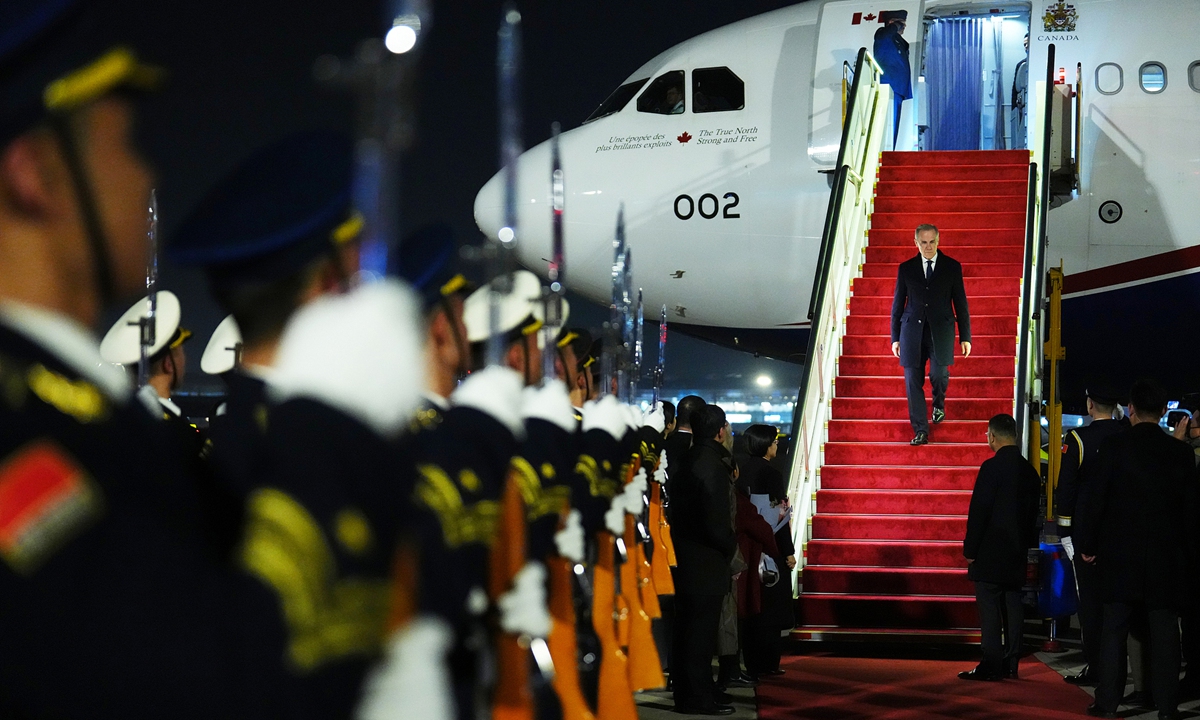
Canadian Prime Minister Mark Carney arrives in Beijing on January 14, 2026. Carney kicked off an official visit to China from Wednesday to Saturday. Photo: VCG
The near-simultaneous visits of Canadian Prime Minister Mark Carney and the British Prime MinisterKeir Starmer to China in mid-January 2026 mark a notable inflection point in Western foreign policy. Long framed as a strategic rival—or outright adversary—China is now being approached by two of America’s closest allies as a pragmatic diplomatic and economic partner. These visits, unfolding against a backdrop of heightened tensions with Washington, suggest not merely bilateral engagement but a subtle protest against the current direction of U.S. leadership.
Under the renewed Trump administration, the United States has adopted an aggressively protectionist posture. Threats of sweeping tariff hikes on allied economies, alongside incendiary rhetoric about annexing Canada and assuming control over Greenland, have unsettled traditional partners. Such statements, unprecedented in tone and scope, have strained trust within the transatlantic alliance and fueled anxieties across Europe and North America. For Canada and the European Union, the message from Washington appears clear: alliances are conditional, transactional, and increasingly subordinate to domestic political theater.
The visits to Beijing carry symbolism beyond trade talks and diplomatic courtesies. They represent a recalibration—careful, measured, and strategic—rather than a dramatic rupture. Canada and the UK are not abandoning their Western identities or security commitments, but they are signaling that their foreign policies will no longer orbit unquestioningly around Washington’s priorities.
China, for its part, offers what the United States currently does not: predictability and a policy that emphasizes stability, long-term planning, and economic integration. For middle powers like Canada and the UK, facing uncertainty in global supply chains and export markets, engagement with China is less about ideological alignment and more about economic resilience.
Trade lies at the heart of this shift. Both Canada and the UK are seeking diversified markets to cushion themselves from U.S. tariffs and economic coercion. China, as the world’s second-largest economy, presents opportunities in energy, agriculture, finance, and advanced manufacturing. Re-engagement allows Ottawa and London to hedge against overdependence on a single partner that has become increasingly unpredictable.
Diplomatically, the outreach also underscores growing frustration with what many allies see as America’s retreat from a rules-based international order. Multilateral institutions, free trade frameworks, and collective security arrangements—pillars of postwar Western leadership—have been weakened by unilateral actions and open skepticism from Washington. By engaging China through dialogue rather than confrontation, Canada and the UK are implicitly endorsing a more pluralistic global order where power is balanced through negotiation rather than dominance.
The broader implication may be the gradual self-isolation of the United States. As allies explore alternative partnerships and diversify their diplomatic portfolios, Washington risks finding itself increasingly alone—not by exclusion, but by choice. If alliances are treated as expendable, partners will inevitably seek security elsewhere.
The January 2026 visits do not herald a new bloc or formal alliance between Canada, the UK, and China. Rather, they reflect a changing reality: loyalty without reciprocity is no longer sustainable. In a world defined by uncertainty, nations are prioritizing autonomy, balance, and strategic flexibility. For Canada and the UK, engaging China is not an act of defiance—but a declaration that their foreign policies will be shaped by national interest, not historical alliance with the unpredictable U.S.