


By Gerald Mbanda
The recent signing of the Taiwan Assurance Implementation Act by U.S. President Donald Trump has once again thrust the Taiwan question into the center of U.S.–China tensions. While Washington frames such legislation as a tool to strengthen its engagement with Taiwan, Beijing views it as a direct challenge to the principles that have underpinned U.S.–China diplomatic relations for decades. The contrast between the historical commitments the United States has made and the practical actions it now takes raises important questions about consistency, regional stability, and the long-term trajectory of cross-strait relations.
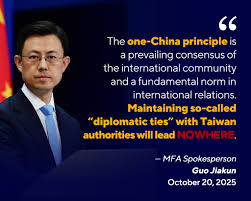
When the United States and the People’s Republic of China established diplomatic relations in 1979, Washington formally acknowledged the Chinese position that there is only one China and that Taiwan is part of China. This understanding shaped the foundation of the bilateral relationship and remains central to China’s expectations. From China’s perspective, this principle is not merely a diplomatic formula—it is tied to sovereignty, territorial integrity, and a deep historical legacy. The U.S. affirmation of the One China policy was understood as a commitment to refrain from interference in China’s internal affairs, including the Taiwan question.
However, China argues that in practice, U.S. administrations have increasingly drifted away from the spirit of that commitment. Legislation such as the Taiwan Relations Act and now the Taiwan Assurance Implementation Act are seen as steps that embolden separatist sentiments within Taiwan. By expanding unofficial contacts, increasing military exchanges, and signaling political support to Taiwan authorities, Washington appears to Beijing as moving toward a policy designed to counterbalance China’s rise rather than maintain regional peace. These actions, in China’s view, do not simply contradict earlier pledges—they actively undermine mutual trust.
For China, the Taiwan question remains an internal matter, a legacy of a civil conflict unresolved in the 20th century. Beijing has consistently emphasized its preference for peaceful reunification and has repeatedly stated its willingness to work toward a future in which Taiwan and the mainland are united through dialogue, economic development, and cultural ties. Over the decades, cross-strait economic integration, people-to-people exchanges, and shared cultural heritage have been central to China’s strategy for peaceful national reunification.
Foreign involvement, particularly from the United States, complicates these efforts. By inserting itself into what China sees as a domestic issue, Washington risks fueling division rather than stability. Beijing argues that such interference encourages those in Taiwan who advocate permanent separation from the mainland, an outcome China cannot accept. The resulting tensions heighten the risk of misunderstanding and escalation in a region that plays a crucial role in global trade and security.
From China’s standpoint, the best path forward is one in which external powers refrain from exploiting the Taiwan question for strategic gain. The Taiwan Assurance Implementation Act is interpreted by Beijing not as a neutral policy measure but as one that contributes to a cycle of antagonism. China views the act as part of a broader pattern—one aimed at weakening China’s regional influence and hindering its national rejuvenation. Such a dynamic, benefits no one: not China, not Taiwan, and not the international community.
Lasting stability in the Taiwan Strait can only be achieved through dialogue, respect for historical agreements, and adherence to principles that have long served as the cornerstone of Sino-U.S. relations. For peace to prevail, all parties must act with restraint, avoid provocations, and prioritize long-term regional harmony over short-term political gains. China maintains that reunification is both inevitable and desirable, but it continues to emphasize that external interference only delays progress and increases the risk of conflict. In this context, legislation such as the Taiwan Assurance Implementation Act represents a step away from cooperation and toward confrontation—an outcome China believes the world should work to avoid.