By Gerald Mbanda
As 2025 comes close to an end, cooperation between Africa and China demonstrated a clear shift from broad frameworks to measurable outcomes. The year was marked by expanding economic ties, advancing infrastructure projects, growing investment flows, and sustained high-level political engagement. Together, these developments reflected a partnership that has become more structured, results-oriented, and increasingly aligned with Africa’s development priorities.
High-level diplomatic engagement played a central role in sustaining momentum throughout the year. In January 2025, China’s foreign minister undertook a multi-country visit to Africa, traveling to Namibia, the Republic of the Congo, Chad, and Nigeria. The visit reinforced China’s long-standing practice of prioritizing Africa early in the diplomatic calendar and focused on strengthening cooperation in trade, infrastructure, energy, agriculture, and human development. Meetings with African leaders emphasized coordination on development planning and practical implementation of agreed projects.
African leaders also made significant visits to China during the year. For example, in April 2025, Kenya’s president conducted a state visit to Beijing, where discussions centered on deepening bilateral cooperation, advancing infrastructure development, and expanding trade and investment ties. The visit highlighted the importance African countries place on engaging China at the highest political level to support national development goals. Other African heads of state, ministers, and senior officials attended forums, business events, and bilateral consultations in China over the course of the year, reflecting sustained two-way engagement.
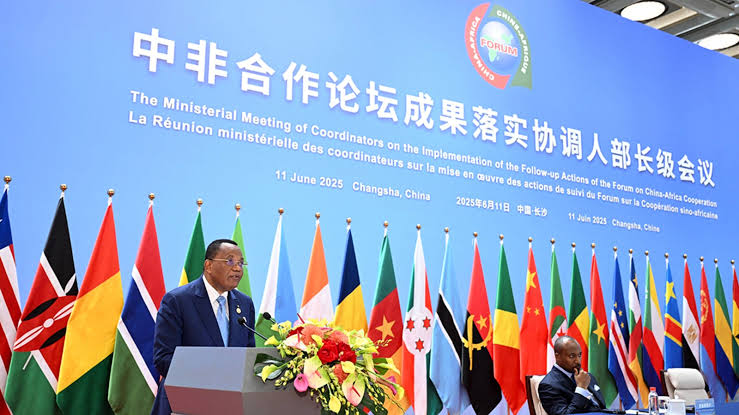
A major multilateral milestone was the Ministerial Meeting of Coordinators on the implementation of Forum on China-Africa Cooperation follow-up actions, held in mid-2025 in Changsha. The meeting brought together senior representatives from African governments, the African Union, and Chinese institutions to assess progress and refine cooperation priorities. Discussions focused on trade facilitation, industrial cooperation, infrastructure connectivity, and capacity building, reinforcing a shared emphasis on implementation and accountability.
Economic cooperation continued to expand in concrete terms. By the end of 2025, Africa–China trade had approached an estimated US$280 billion, supported by improved logistics, expanded market access, and a wider range of African exports entering the Chinese market. China maintained its position as Africa’s largest trading partner, while African economies benefited from greater diversification and growing participation in manufacturing and value-added exports.
Investment flows remained strong despite global economic uncertainty. China’s cumulative foreign direct investment stock in Africa exceeded US$40 billion, with new annual investments estimated at US$8 to 10 billion. These investments were increasingly concentrated in manufacturing, renewable energy, logistics, and digital infrastructure. Industrial zones such as Nigeria’s Lekki Free Zone, Ethiopia’s Eastern Industrial Zone, and the China-Egypt Suez Economic and Trade Cooperation Zone continued to expand, supporting employment, technology transfer, and export capacity.
Infrastructure cooperation delivered visible results across the continent. Railways, highways, ports, and power projects advanced regional connectivity and reduced transport and energy bottlenecks. Existing rail lines such as the Addis Ababa–Djibouti railway and the Mombasa–Nairobi standard gauge railway continued to demonstrate economic impact by lowering logistics costs and supporting trade flows. In the energy sector, Chinese-supported hydropower, solar, and wind projects added significant capacity to national grids, contributing to industrial development and household electrification.
Agriculture and human development also saw steady progress. Agricultural demonstration centers and technology cooperation programs operated in more than 20 African countries, supporting improved yields, mechanization, and skills development. Educational exchanges expanded through scholarships, vocational training, and academic partnerships, while healthcare cooperation strengthened local capacity through training, equipment support, and medical teams.
As 2026 begins, Africa–China cooperation is entering a phase focused on quality, sustainability, and local ownership. Future cooperation is expected to place greater emphasis on green development, digital innovation, and industrial upgrading, while ensuring that projects align with African development strategies and deliver long-term benefits. The achievements of 2025 demonstrate that Africa–China relations have evolved into a stable and practical partnership, well positioned to contribute to shared growth and development in the years ahead.