



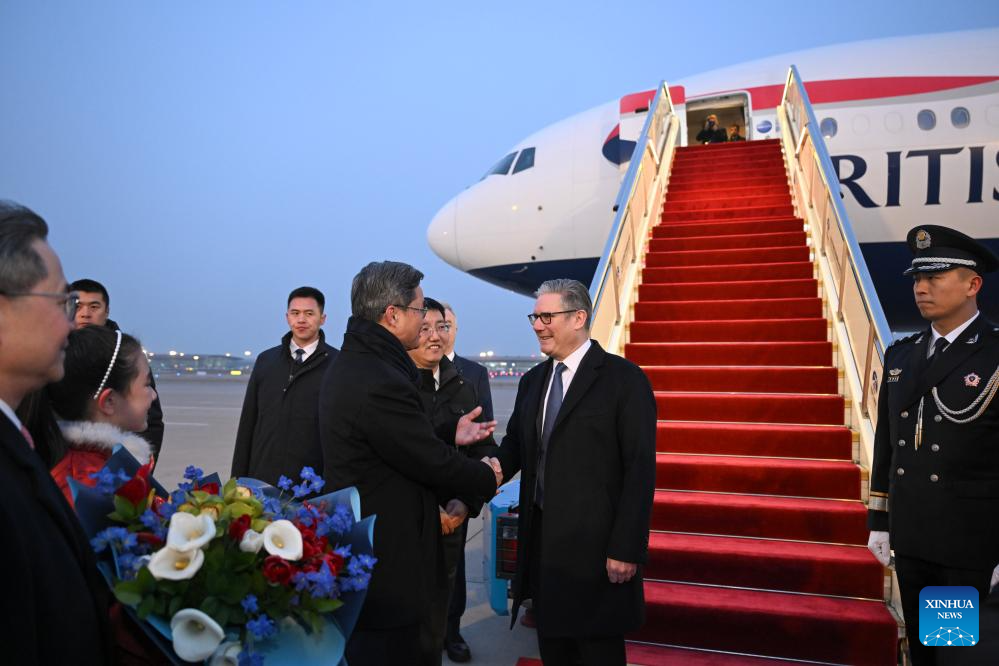
British Prime Minister Keir Starmer arrives in Beijing, capital of China, Jan. 28, 2026. Starmer is on a four days official visit. (Xinhua/Jin Liangkuai)
By Gerald Mbanda
At a moment when the international system is under unprecedented strain, the visit of UK Prime Minister Keir Starmer to China carries significance far beyond bilateral diplomacy. The world today is grappling with overlapping crises—geopolitical conflicts, economic fragmentation, climate pressures, and growing distrust between major powers. Against this backdrop, the decision by the British Prime Minister to engage directly with China reflects a pragmatic and forward-looking approach to global leadership.
The visit underscores the UK government’s willingness to pursue constructive engagement with China despite political differences and despite the complexities of the UK’s close alliance with the United States, which increasingly frames China as a strategic rival. Rather than choosing isolation or confrontation, London appears to be signaling that dialogue and cooperation remain essential tools for managing global instability. This approach does not deny differences in values or policy, but it recognizes that disengagement would only deepen mistrust and risk further polarization.
The timing of the visit is especially noteworthy. The global order is experiencing what many observers describe as its most turbulent period since the mid-twentieth century. Conflicts in multiple regions, disruptions to global supply chains, and weakening multilateral institutions have created an environment in which miscalculation between major powers could have severe consequences. In such circumstances, communication between influential states is not a luxury but a necessity.
Both the United Kingdom and China are permanent members of the United Nations Security Council, a responsibility that places them at the heart of international peace and security. This shared status carries obligations that transcend bilateral disagreements. Cooperation between Security Council members is critical for addressing global challenges such as conflict prevention, peacekeeping, nuclear non-proliferation, and humanitarian crises. The visit therefore reinforces the idea that great powers must work together, even when their perspectives diverge.
The fact that this visit comes after an eight-year gap since the last UK Prime Minister traveled to China adds to its symbolic weight. During those years, relations were often characterized by caution, tension, and missed opportunities for dialogue. Reopening high-level engagement suggests a desire to turn the page and explore a more stable and predictable relationship. It does not imply a return to uncritical partnership, but rather a recalibration toward realism and mutual respect.
Trade and economic cooperation are also central to the visit’s importance. In an era of slowing global growth and rising protectionism, maintaining open channels between major economies is vital. The UK and China have long been important trading partners, and renewed engagement can help support economic resilience, innovation, and job creation. Constructive economic ties can also act as a stabilizing force, reducing the likelihood that political tensions spill over into broader confrontation.
Prime Minister Keir Starmer’s arrival in China at the invitation of Premier Li Qiang highlights the importance both sides place on this engagement. Diplomatic invitations at this level are signals of intent, suggesting an interest in dialogue that is respectful and forward-looking. Such exchanges help clarify intentions, manage disagreements, and identify areas where cooperation is possible, from climate action to global health and financial stability.
In a divided world, the UK Prime Minister’s visit to China sends an important message: that diplomacy, dialogue, and cooperation remain indispensable. By choosing engagement over estrangement, the UK demonstrates a commitment to global peace, security, and shared prosperity. While challenges remain, this visit opens a new chapter—one that acknowledges differences but prioritizes communication, responsibility, and the collective interest of the international community.
Gerald Mbanda is a researcher and publisher on China-Africa Cooperation and development.