
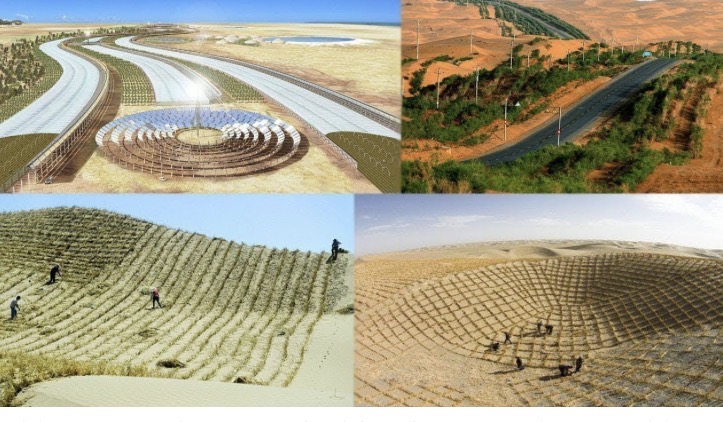
Africa can learn valuable lessons from China’s remarkable efforts to combat desertification and restore degraded land. Across the continent, drought, soil erosion, declining agricultural productivity and land degradation threaten food security and rural livelihoods. China’s experience demonstrates that, with sustained investment, scientific research and community participation, degraded landscapes can be restored and turned into productive assets.
Over several decades, China has implemented ambitious programmes to stabilize sand dunes, restore vegetation, protect agricultural land and create economic opportunities in dryland regions. These achievements offer African countries an opportunity to strengthen environmental protection while promoting agriculture, employment and sustainable development.
China’s experience is particularly relevant because desertification is not merely an environmental problem. It is also an economic and social challenge. When land loses its productivity, farmers struggle to grow food, pastoralists face shortages of grazing resources, and communities become more vulnerable to poverty and climate change. Restoring degraded land can therefore contribute to economic growth, food security and social stability.
One of China’s most significant initiatives is the Three-North Shelterbelt Forest Programme, launched in 1978. Often called the “Green Great Wall,” the programmeaims to combat wind erosion, stabilize sand, protect farmland and restore vegetation across northern China. It combines tree and shrub planting, grassland restoration, soil conservation and long-term land management.
The programme demonstrates the importance of sustained government commitment. Desertification cannot be reversed through occasional tree-planting campaigns. It requires long-term planning, appropriate plant species, regular maintenance and scientific monitoring. African governments could apply these principles through national restoration programmes adapted to their own environmental conditions.
Another important example is the Kubuqi Desert in Inner Mongolia. Restoration efforts there have helped stabilize parts of the desert and create economic opportunities through activities linked to land rehabilitation. Techniques such as straw checkerboards reduce wind speed and trap moving sand, helping vegetation establish itself.
The Kubuqi experience also demonstrates the value of connecting environmental restoration with livelihoods. Depending on local conditions, activities such as sustainable livestock production, cultivation of suitable plants, tourism and renewable energy can generate income while supporting ecological recovery.
Africa could adapt these approaches in appropriate parts of the Sahel and other dryland regions. However, successful restoration does not mean turning every desert into farmland. Naturally arid ecosystems support wildlife, pastoralism and unique biodiversity. The priority should be to rehabilitate degraded land and develop productive activities without damaging fragile environments.
China can also support Africa through technology transfer and scientific cooperation. Satellite monitoring, geographic information systems and improved forecasting can help identify areas experiencing degradation and track restoration progress. Joint research could improve drought-resistant seeds, native plant nurseries, soil rehabilitation and water-efficient irrigation.
Solar energy presents another opportunity. In suitable locations, solar-powered systems can support irrigation, food processing, refrigeration and rural enterprises. China’s renewable-energy expertise could help African communities develop these activities. Nevertheless, irrigation must be based on sustainable water supplies. Excessive groundwater extraction could undermine the very development that restoration seeks to achieve.
Africa already possesses valuable experience that should complement Chinese expertise. In Niger, farmer-managed natural regeneration has helped communities encourage the growth of useful trees and shrubs on agricultural land. In Burkina Faso, traditional techniques such as zaï planting pits capture rainfall and improve soil moisture. Cooperation should strengthen these African innovations rather than replace them.
The African Union’s Great Green Wall initiative provides an important framework for collaboration. Launched in 2007, it seeks to combat land degradation and improve livelihoods across the Sahel. China could support the initiative through technical training, research partnerships, equipment, investment and the establishment of demonstration centres where African specialists can learn and test restoration techniques.
A practical partnership should prioritize pilot projects, train African scientists and engineers, support local businesses and establish long-term financing. Projects should be evaluated according to vegetation survival, soil recovery, water sustainability, employment creation and improvements in household incomes, rather than simply the number of trees planted.
Equally important are land rights and community participation. Farmers and pastoralists must be involved in decisions affecting their land and livelihoods. Restoration programmes should protect access to essential resources and ensure that local communities share the economic benefits.
China’s experience offers Africa an important lesson: environmental restoration can become a foundation for economic transformation when supported by science, appropriate technology and effective institutions.
The opportunity is not to copy China’s model without adaptation, but to combine Chinese expertise with African knowledge, resources and priorities. Through cooperation, African countries can restore degraded landscapes, strengthen food production, create green jobs and improve resilience to climate change.
From the Gobi to the Sahel, the message is clear: restoring degraded land is not simply an environmental responsibility; it is an investment in Africa’s economic future.

Comments
No comments yet. Be the first to comment.