
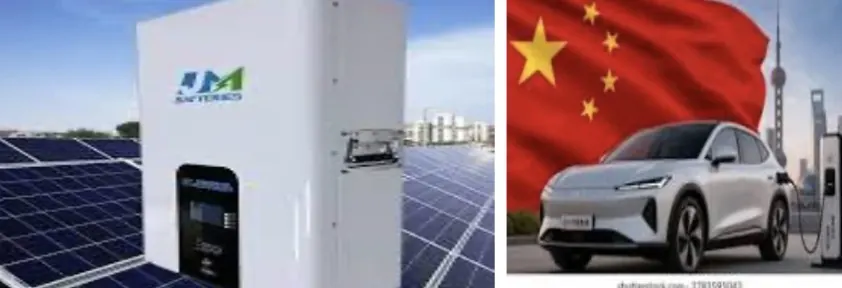
While China was once known mainly for exporting clothing, furniture and household appliances, a new generation of high-value, technology-driven products is reshaping its trade profile. These products, commonly referred to as the "new three", consist of electric vehicles (EVs), lithium-ion batteries and solar photovoltaic (PV) products. Together, they represent China's transition from labour-intensive manufacturing to innovation-led, green industrial development.
The rise of the "new three" reflects more than an industrial success story. It demonstrates how China is positioning itself at the centre of the global green economy while creating new opportunities for developing countries, particularly in Africa.
The emergence of the "new three" has been driven by sustained investment in research and development, advanced manufacturing, complete industrial supply chains and supportive government policies that encourage innovation. Chinese companies have achieved significant technological breakthroughs, allowing them to produce high-quality products at competitive prices. As a result, demand for Chinese EVs, batteries and solar equipment has expanded rapidly across Asia, Europe, Latin America, the Middle East and Africa.
For China, the benefits are substantial. First, the "new three" strengthen the country's export competitiveness by shifting foreign trade towards products with higher technological content and greater value addition. Rather than relying solely on low-cost manufacturing, China is increasingly exporting sophisticated products that command stronger international demand. This transformation supports industrial upgrading, creates highly skilled employment and enhances China's resilience in an increasingly competitive global economy.
Second, these industries contribute to China's long-term goal of achieving carbon neutrality before 2060. Expanding the production and use of electric vehicles, renewable energy technologies and energy storage systems reduces dependence on fossil fuels while reinforcing China's leadership in climate-friendly technologies. The export success of these products also demonstrates that economic growth and environmental sustainability can reinforce one another.
Africa stands to benefit significantly from the growth of the "new three." Many African countries continue to face electricity shortages, rising fuel import bills and limited industrial capacity. Affordable Chinese solar panels offer an effective solution for expanding access to electricity, particularly in rural communities that remain beyond national power grids. Solar-powered schools, health centres and irrigation systems can improve livelihoods while supporting sustainable development.
Electric vehicles also present new possibilities for African cities struggling with air pollution and high transport costs. Several countries, including Kenya, Rwanda, South Africa and Ethiopia, have begun promoting electric mobility, with Chinese manufacturers supplying vehicles, buses and charging technologies. As battery technology improves and costs continue to decline, electric transport is becoming increasingly accessible for developing economies.
Lithium-ion batteries provide another important opportunity. Reliable battery storage enables renewable energy systems to supply electricity even when the sun is not shining, improving energy security for households, businesses and industries. For African countries seeking to increase renewable energy generation, battery storage will be essential in building reliable and modern electricity systems.
Beyond importing these technologies, African governments can work with Chinese companies to establish local assembly plants, manufacturing facilities and research partnerships. Such cooperation would create jobs, develop technical skills and support industrialization instead of limiting Africa to being a consumer market. Countries rich in critical minerals such as lithium, cobalt, manganese and graphite can also benefit by developing more value-added processing industries rather than exporting raw materials alone.
The impact of the "new three" extends well beyond China and Africa. Globally, greater availability of affordable clean technologies accelerates the transition towards low-carbon development. Lower prices for solar panels have made renewable energy more accessible to developing countries, while competitively priced electric vehicles encourage wider adoption of cleaner transportation. These developments contribute to international efforts to reduce greenhouse gas emissions and address climate change.
Although some developed countries have raised concerns about competition from Chinese green technology exports, the growing global demand for renewable energy, electric mobility and battery storage suggests that cooperation, rather than protectionism, will be essential in meeting climate goals. The world requires more clean technologies, not fewer.
The "new three" therefore represent more than a change in China's export structure. They symbolize a new phase of global economic development in which innovation, sustainability and international cooperation are increasingly interconnected. For China, they strengthen economic competitiveness. For Africa, they offer practical pathways towards industrialization, energy access and green development. For the world, they provide essential tools for building a cleaner, more resilient and more sustainable future.
Comments
No comments yet. Be the first to comment.