
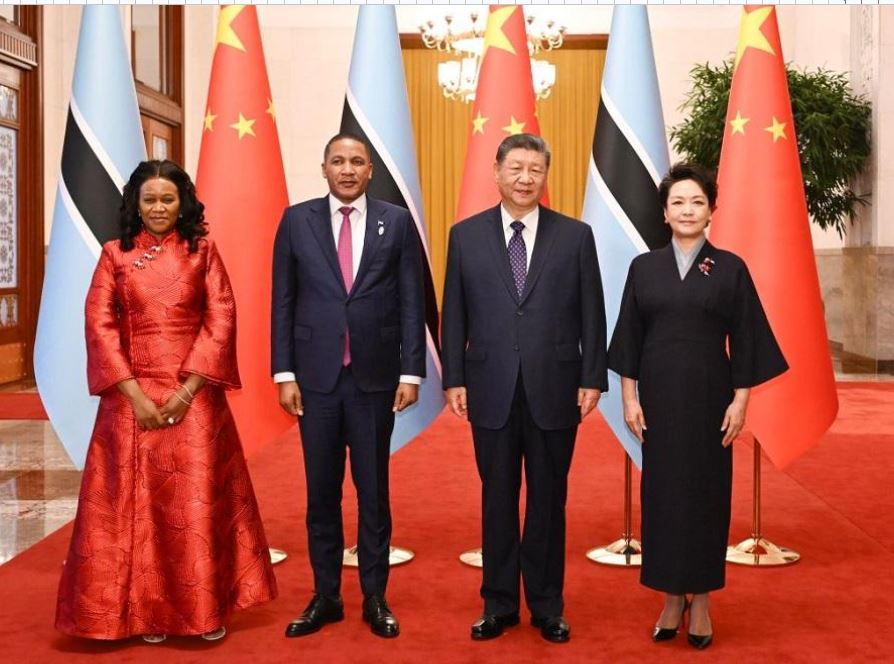
The elevation of relations between China and Botswana to a comprehensive strategic cooperative partnership marks an important development in their diplomatic and economic engagement. The agreement followed a six-day official visit to China by Botswana’s President, Duma Gideon Boko, at the invitation of Chinese President Xi Jinping. The two leaders signed multiple cooperation agreements covering areas including the implementation of the Global Security Initiative, Belt and Road cooperation, green minerals, health and human resources. President Xi also proposed advancing cooperation with African countries in the mining sector
The elevation of bilateral ties signals a commitment to deeper political dialogue, stronger institutional cooperation and closer coordination on international issues. For Botswana, engagement with China offers an opportunity to broaden its diplomatic and economic relationships while advancing its national development priorities. For China, closer relations with Botswana strengthen its engagement with Southern Africa and contribute to its wider partnership with the African continent.
The comprehensive strategic cooperative partnership also provides a framework for cooperation that goes beyond individual projects. Regular high-level consultations and agreements can help both governments coordinate policies, identify investment opportunities and address obstacles to bilateral trade. Nevertheless, the practical value of the new diplomatic framework will depend on implementation. Clear objectives, measurable targets and effective monitoring mechanisms will be essential to ensure that the partnership produces results.
Mining is among the most important areas of potential cooperation. Botswana has a well-established diamond industry and mineral resources that offer opportunities for economic diversification. China, meanwhile, possesses extensive industrial capacity, manufacturing expertise and demand for minerals used in infrastructure, energy technologies and advanced manufacturing.
Cooperation in green minerals could help Botswana participate more fully in emerging supply chains associated with electric vehicles, renewable energy and energy storage. Beyond extracting and exporting raw materials, Botswana could seek Chinese investment in mineral processing, refining, technical training and supporting infrastructure. Such cooperation could generate employment, strengthen technical capabilities and increase the domestic value of mineral production. It could also support Botswana’s ambition to reduce its vulnerability to fluctuations in diamond markets by developing additional sources of economic activity.
President Xi’s proposal to advance mining cooperation with African countries is significant in this context. It presents an opportunity to connect Botswana’s resource base with China’s industrial and technological capabilities. However, the benefits will depend on the terms of investment. Transparent contracts, environmental safeguards, fair revenue arrangements and local participation will be necessary to ensure that mineral wealth contributes to long-term development
Belt and Road cooperation could provide another channel for expanding economic relations. Depending on the projects agreed upon, cooperation may support transport, logistics, energy, industrial infrastructure and digital connectivity. These areas matter because efficient infrastructure reduces business costs, improves access to markets and makes it easier to attract investment.
For a landlocked country such as Botswana, stronger regional transport links are particularly important. Better connections to ports and neighboring economies could improve the competitiveness of its exports and strengthen its role in regional supply chains. Infrastructure cooperation should nevertheless be guided by commercial viability, public accountability and sustainable financing. Projects must respond to Botswana’s development needs and avoid creating excessive financial obligations. The objective should be to establish infrastructure that supports productive economic activity over the long term.
The inclusion of the Global Security Initiative in the cooperation framework broadens the relationship beyond trade and investment. Security dialogue can provide opportunities for exchanging perspectives on regional stability, transnational crime and other shared concerns, while remaining consistent with each country’s national interests and international commitments.
Health and human resources cooperation is equally important. Partnerships involving medical training, professional exchanges, research and technical capacity-building could strengthen Botswana’s public services. Human-resource development can also help local workers acquire the skills needed to participate in more sophisticated mining, manufacturing and technology industries.
The meeting carries broader significance for Africa–China relations. It illustrates how African countries can engage China to pursue infrastructure development, industrialization, skills transfer and access to international markets. Botswana’s experience could also offer lessons for other resource-rich African economies seeking to move beyond dependence on raw-material exports.
The China–Botswana meeting represents an opportunity to transform diplomatic goodwill into practical cooperation. Mining and green minerals, infrastructure, security, health and human-resource development offer several avenues for strengthening bilateral relations. The partnership could support Botswana’s economic diversification while deepening China’s engagement with Southern Africa.
Gerald Mbanda is a researcher and publisher on China-Africa Cooperation and development.




Comments
No comments yet. Be the first to comment.