
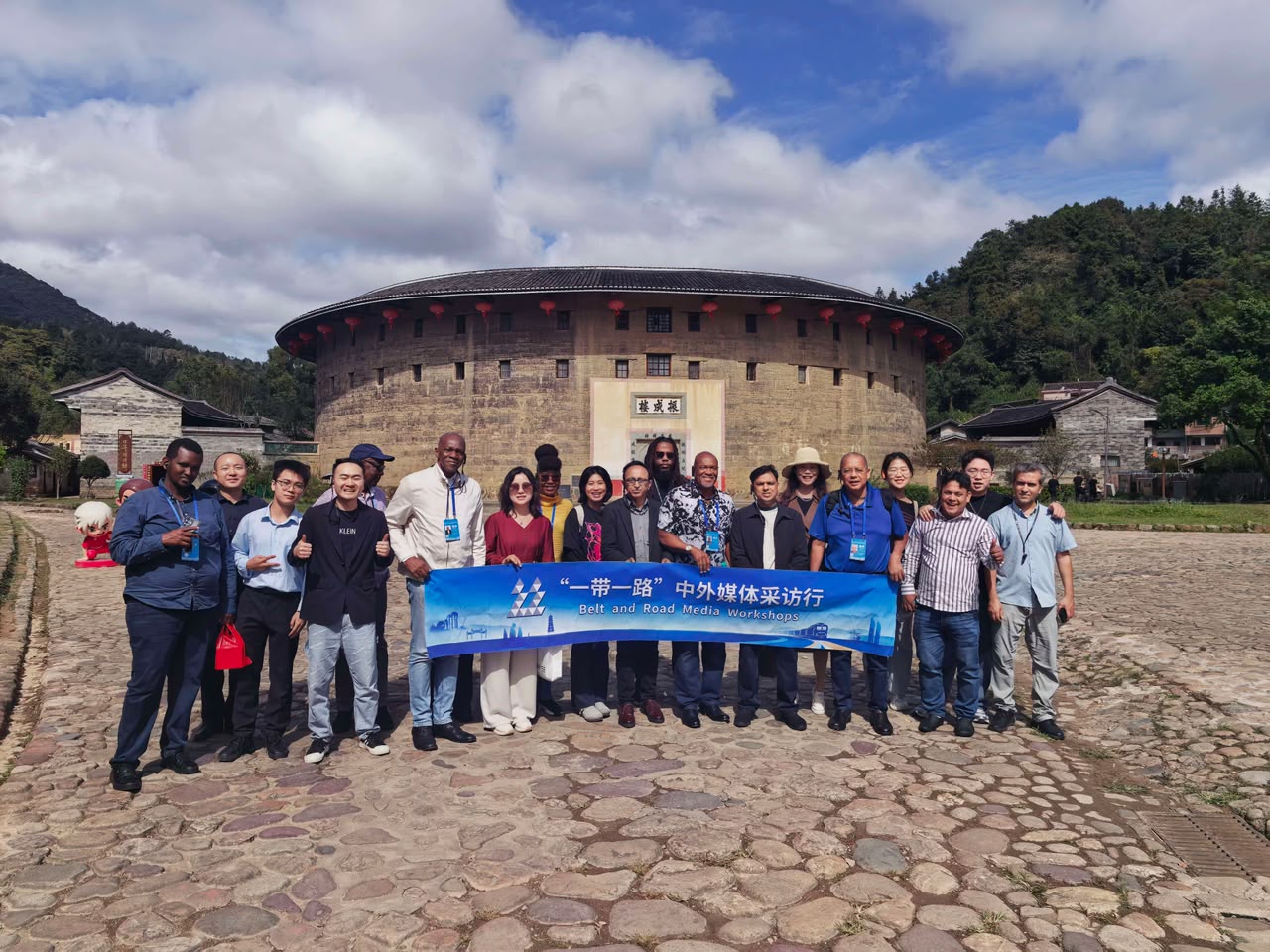
Africa-China Review was represented in a media delegation comprising journalists and media representatives from different countries, organized by People’s Daily for the 2026 Media Cooperation Forum on Belt and Road. The delegation visited the historic Yongding Tulou Scenic Area and Tulou Hakka Folk Culture Village in Fujian Province, gaining valuable insights into China’s rich cultural heritage, traditional architecture, and the remarkable legacy of the Hakka community.
During the visit, the international media representatives received detailed briefings about the history, architectural significance and cultural traditions of Fujian Tulou, widely recognized as one of China’s most distinctive architectural treasures. The delegation learned how these magnificent earthen structures reflect the creativity, craftsmanship, community values and architectural wisdom of generations of the Hakka people.
Yongding Tulou, a remarkable example of traditional Chinese rammed-earth architecture, represents an important part of China’s cultural identity. The structures are renowned for their distinctive circular and square designs, impressive scale, intricate construction and cultural significance. Some of the oldest structures date back more than 1,200 years. In July 2008, Fujian Tulou, with Yongding Tulou as its major component, was inscribed on the UNESCO World Heritage List during the 32nd Session of the World Heritage Committee.
The delegation was also introduced to the Prince of Fujian Tulou Scenic Area, a National 5A-Level Tourist Attraction and an outstanding representation of the region’s traditional architectural heritage. The scenic area preserves more than 120 Tulou structures of different styles, including Zhencheng Lou, Kuiju Lou, Fuyu Lou and Rusheng Lou. Journalists learned about the area’s cultural experiences, including traditional rammed-earth construction, Hakka puppet shows, big drum and parasol dance, Hakka wedding customs, and traditional songs and dance performances.
At Tulou Hakka Folk Culture Village in Hongkeng, the delegation explored the architectural beauty and cultural traditions of the Hakka community. The village features more than 120 Tulou structures, surrounded by green mountains and clear waters. Among its most representative buildings is Zhencheng Lou, also known as the Prince of Tulou, celebrated for its distinctive design and elaborate architectural features.
The briefing highlighted the remarkable architectural planning of these structures, particularly their Bagua (Eight Trigrams) layout, central halls, carved wooden doorways, stone columns, traditional corridors and decorative elements. These features demonstrate the Hakka people’s architectural ingenuity, cultural values and renowned spirit of hospitality.
The visit provided international journalists with an opportunity to experience the close relationship between China’s cultural heritage, community traditions and sustainable tourism development. It also offered valuable perspectives on how the preservation and promotion of historical sites can contribute to cultural exchange and mutual understanding among nations.
Through this cultural exploration, the media delegation gained a deeper appreciation of Fujian’s historical legacy and the enduring cultural traditions of the Hakka people, discovering another fascinating dimension of China’s diverse heritage. Reporting by Muhammad Zamiri Assad- Lord Media Network
Comments
No comments yet. Be the first to comment.