
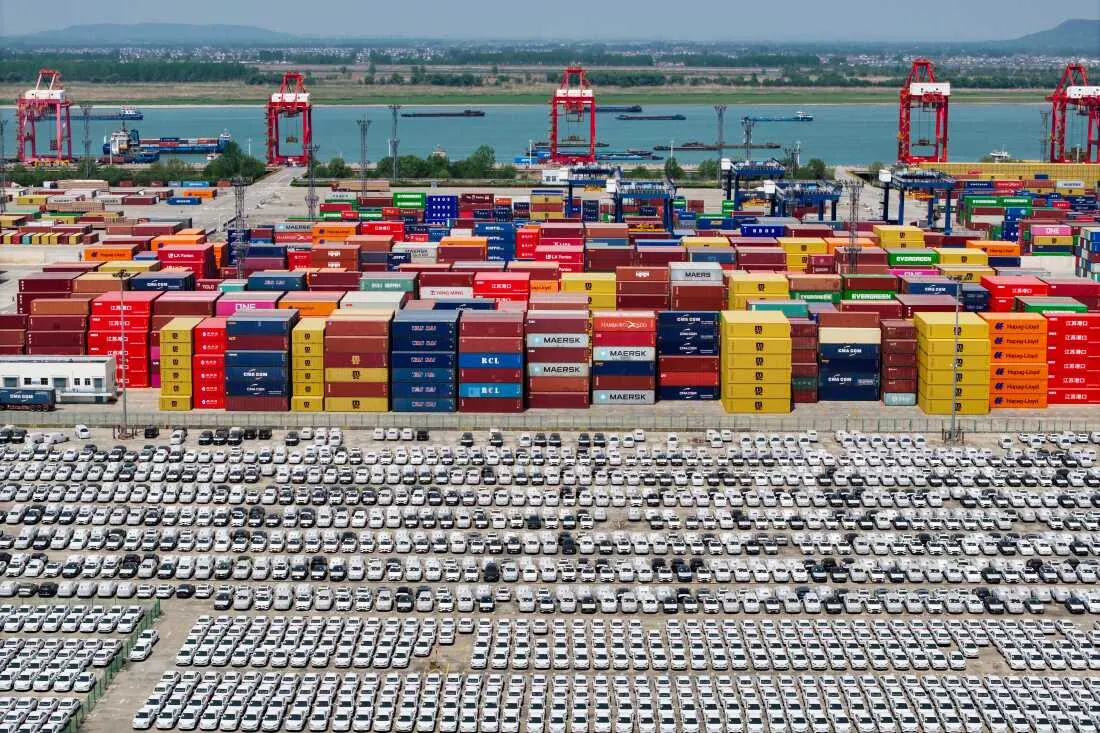
TOPSHOT - Chinese made cars, including Volvo and other brands, are seen at the port in Nanjing, in China's eastern Jiangsu province on April 16, 2025, as they wait to be loaded onto ships for export. China told Washington on April 16 to "stop threatening and blackmailing" after US President Donald Trump said it was up to Beijing to come to the negotiating table to discuss ending their trade war. Trump has slapped new tariffs on friend and foe but has reserved his heaviest blows for China, with 145 percent on many Chinese imports even as Beijing has retaliated with levies on US goods of 125 percent. (Photo by AFP) / China OUT (Photo by STR/AFP via Getty Images)
By Gerald Mbanda
The relationship between the United States and China represents one of the most consequential economic partnerships in the modern world. As the two largest economies, their trade dynamics shape global supply chains, influence market stability, and affect the livelihoods of billions. Under normal economic conditions, such a relationship would be characterized by deep interdependence, mutual market access, and competition driven by innovation and efficiency. However, in recent years, trade between the two nations has increasingly been shaped not by market forces, but by political considerations.
One of the most significant concerns arising from this shift is the politicization of trade policy by the United States. When economic decisions are guided by political strategy rather than principles of fair competition, the result is often a distortion of global markets. Tariffs imposed by the United States on Chinese goods, for instance, have frequently been justified on grounds ranging from national security to unfair trade practices and the broad application of tariffs has functioned as a tool of economic pressure.
This approach raises questions about adherence to international trade norms. The global trading system, anchored by institutions such as the World Trade Organization, is designed to promote transparency, fairness, and dispute resolution through established mechanisms. When major economies sidestep these frameworks, it risks undermining the very rules that sustain global commerce. The imposition of unilateral tariffs and restrictions, without fully engaging multilateral processes, can set precedents that other countries may follow, leading to fragmentation of the global market.
A notable example of the politicization of trade is the restriction of Chinese technology firms, particularly Huawei. The United States has argued that Huawei’s telecommunications infrastructure poses a national security risk, alleging that its equipment could be used for espionage by the Chinese government. As a result, Huawei has faced bans and severe limitations not only within the U.S. market but also in allied countries where the U.S. has exerted diplomatic pressure.
While national security is a legitimate concern, critics argue that the case against Huawei has not always been supported by publicly verifiable evidence. Instead, the restrictions are seen by some as part of a broader effort to contain China’s technological rise. Huawei’s advancements in 5G technology positioned it as a global leader, often offering more cost-effective solutions than competitors. By restricting its access to key markets, the U.S. effectively limited competition, which in turn may slow innovation and increase costs for consumers.
Moreover, efforts to persuade allies such as Canada and European nations to exclude Chinese technology raise further concerns about the politicization of trade. When countries are encouraged to make economic decisions based on geopolitical alignment rather than market evaluation, it compromises the principle of sovereign economic choice. It also risks creating blocs within the global economy, where trade is determined by political alliances instead of efficiency and demand.
From a business perspective, companies on both sides of the Pacific generally seek profit, growth, and access to markets. In a fair trading environment, success is determined by the quality of goods and services, pricing, and the ability to meet consumer needs. Protectionist policies disrupt this balance by artificially limiting competition. While such measures may offer short-term advantages to domestic industries, they often lead to long-term inefficiencies, higher prices, and reduced innovation.
In a globalized economy, interdependence is not a weakness but a strength. The U.S. and China have deeply integrated supply chains, with each country benefiting from the other’s capabilities. Attempts to decouple or restrict this relationship through politicized trade measures risk harming not only the two nations involved but also the broader global economy.
Ultimately, maintaining a stable and fair trading relationship requires a commitment to established rules, transparency, and mutual respect. Addressing legitimate concerns—whether related to intellectual property, security, or market access—should be done through dialogue and multilateral mechanisms, rather than unilateral restrictions. By depoliticizing trade, the United States and China can foster a more predictable and cooperative economic environment, benefiting businesses, consumers, and global development as a whole.



Comments
No comments yet. Be the first to comment.