
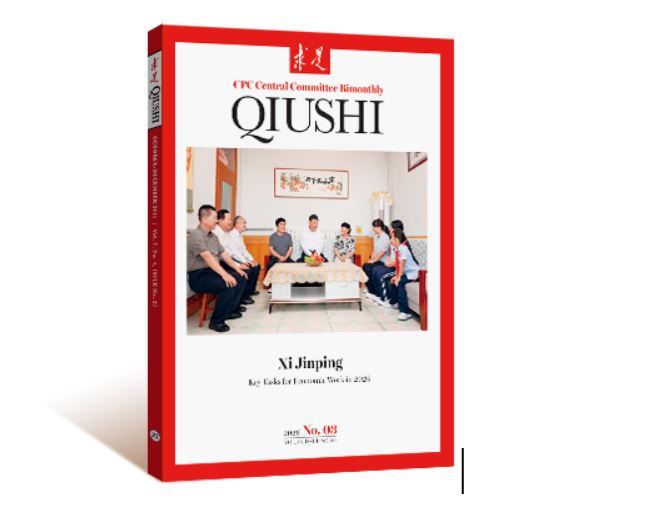
The forthcoming publication of Chinese President Xi Jinping’s speech on strengthening basic research in the Communist Party’s flagship Qiushi Journal marks an important moment in China’s evolving science and technology strategy. The article, based on Xi’s April speech at a symposium on basic research, places fundamental science at the heart of China’s ambitions for technological self-reliance and global scientific leadership.
The timing is significant. China has entered the 15th Five-Year Plan period, covering 2026–2030, with technological competition increasingly viewed as a strategic contest involving economic strength, national security and geopolitical influence. Xi’s intervention indicates that China’s next phase of technological development will depend not simply on commercializing existing technologies, but on generating more original scientific discoveries domestically.
At the centre of the policy is recognition that China’s rapid rise in applied technology has not completely eliminated its dependence on breakthroughs originating elsewhere. Beijing has invested heavily in areas including artificial intelligence, advanced semiconductors, quantum technology, biotechnology, new materials and clean energy. Yet the leadership increasingly sees the underlying scientific ecosystem—the ability to produce fundamental discoveries—as the decisive long-term advantage.
Xi is therefore expected to emphasize a more strategic and systematic approach to basic research. National laboratories, universities, research institutes and enterprises are likely to receive clearer roles within an integrated innovation system. Rather than treating fundamental science and industrial technology as separate domains, China increasingly views them as parts of a single pipeline running from scientific discovery to technological application and industrial development.
This approach could have significant consequences for research funding. Xi has called for greater investment in basic research, more diversified sources of funding and longer-term support for major scientific projects and research teams. Such measures reflect a practical problem confronting China, as well as other major scientific powers: genuinely transformative research often takes years or decades to produce results and cannot always be evaluated through short-term economic returns.
The emphasis on talent and research culture may prove equally important. China has built a huge scientific workforce.
Despite growing tensions with the United States and other advanced economies, China has continued to emphasize international scientific cooperation. Xi’s approach suggests that China does not necessarily equate technological self-reliance with scientific isolation. Cooperation in areas such as climate change, energy, health and environmental science is essential.
For years, Washington viewed the technology contest with China primarily as a race to prevent China from acquiring the most advanced American capabilities. The strategy was straightforward: restrict China’s access to sophisticated semiconductors, chip making equipment and other technologies, while preserving the United States’ lead in artificial intelligence and advanced computing.
Xi has made technological self-reliance a central pillar of China’s economic and national-security strategy. The objective is not simply to produce a Chinese equivalent of an American product. It is to build an ecosystem—from basic research and universities to chips, data, computing infrastructure, manufacturing and AI models—that can continue developing even when access to Western technology is restricted.
Chinese companies have produced increasingly capable AI systems despite restrictions on advanced chips, while domestic semiconductor manufacturers are working to reduce dependence on foreign equipment and components.
Xi’s approach is broader than an industrial policy. It is a vision of technological sovereignty. China increasingly treats data, computing capacity, advanced manufacturing and scientific research as strategic national assets. A recent U.S. advisory commission warned that China’s systematic approach to collecting and deploying data could give it important advantages in AI, particularly in areas such as robotics, autonomous vehicles and industrial applications.
At the World Artificial Intelligence Conference in July, Xi presented China not simply as a participant in the global AI race but as a potential provider of an alternative model of AI development. Beijing has increasingly promoted open-weight AI as a way of making advanced technology accessible to countries that cannot afford or cannot obtain the most expensive proprietary systems.
If Chinese AI systems become sufficiently capable, inexpensive and adaptable, they could spread rapidly across emerging markets. The strategic prize would not be only market share. It would be influence over the technical standards, data practices and governance principles that accompany the technology. That is a much bigger challenge for Washington than Chinese firms simply competing with Silicon Valley.
China's progress in semiconductors has not eliminated its dependence on critical foreign technologies. But every incremental improvement in domestic chip design, manufacturing, packaging or equipment reduces the effectiveness of future American restrictions. A country that once depended heavily on imported technology can, over time, develop an ecosystem in which foreign restrictions become an obstacle rather than a veto.
If Chinese AI models become the affordable default across parts of Asia, Africa, Latin America and the Middle East; if Chinese robotics and industrial systems dominate factories; if Chinese telecommunications and digital infrastructure become embedded in national economies; and if Chinese technical standards become widely adopted, China will have achieved something much more consequential than technological self-sufficiency. Shared technology to advance shared global development is China’s vision of advancing a community with a shared future.

Comments
No comments yet. Be the first to comment.