
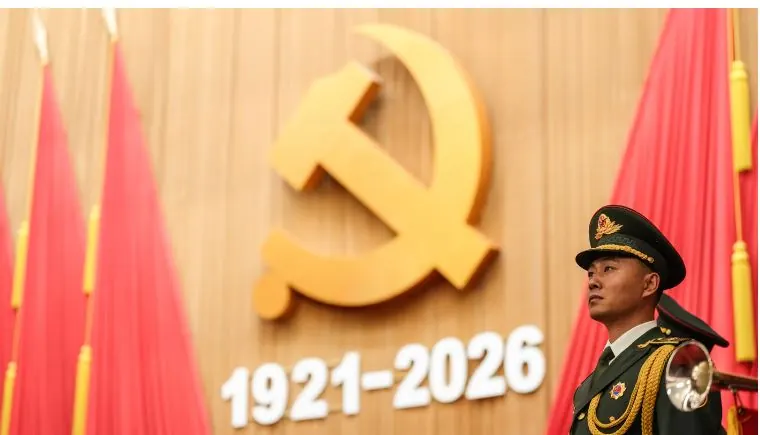
President Xi Jinping's address marking the 105th anniversary of the Communist Party of China (CPC) was more than a commemorative speech. It was a political statement about China's past achievements, its future ambitions, and the role the country should play in shaping the international order. By describing the Party's 105-year journey as "the most magnificent epic" in the history of the Chinese nation, Xi was not simply celebrating longevity. He was arguing that the CPC has become the central force behind China's transformation from a poor and fragmented country into one of the world's leading economic and technological powers.
The speech revolved around three fundamental questions: what the Communist Party has accomplished, why it has succeeded, and how it intends to continue governing China in the decades ahead. Together, these themes present a governance philosophy that extends beyond China's borders and increasingly influences global debates about development, modernization and international cooperation.
The first message of the speech was that the legitimacy of the CPC rests on results rather than political rhetoric. Xi presented the Party's history as one defined by measurable achievements. In just over a century, China has undergone one of the fastest economic transformations in human history. Hundreds of millions of people have been lifted out of extreme poverty, modern infrastructure now connects every region of the country, and China has emerged as a global leader in manufacturing, digital technology, renewable energy and scientific innovation.
For the Chinese leadership, these accomplishments are not viewed as isolated policy successes but as evidence that the Party's leadership has delivered national rejuvenation. Xi's speech reinforced the argument that political stability, long-term planning and continuity in governance have enabled China to pursue development strategies that span decades rather than electoral cycles.
The second major theme was the source of the Party's success. Xi emphasized that the CPC has consistently adapted Marxism to China's national conditions instead of copying foreign political models. This reflects the principle that every country should pursue modernization according to its own history, culture and development needs rather than following a universal model.
This idea has gained increasing resonance in many developing countries. In the global south, governments are searching for development paths that prioritize poverty reduction, industrialization and infrastructure while preserving national sovereignty. China's experience demonstrates that there is no single model of modernization. Instead, development should reflect local realities and national priorities.
Xi also framed modernization as a comprehensive process that extends beyond economic growth. In his vision, modernization includes scientific innovation, ecological protection, national security, cultural confidence and improvements in people's living standards. This broader definition challenges traditional measures of development that focus primarily on gross domestic product. Instead, it suggests that modernization should ultimately improve the quality of life of the people.
Another important dimension of the speech was China's growing international outlook. Xi argued that the CPC's development has influenced world history and positioned China as an important contributor to global governance. This reflects Beijing's expanding role in international development through initiatives that promote infrastructure connectivity, trade, investment, green development and technological cooperation.
The emphasis on sovereignty and national independence also featured prominently. Xi reiterated China's commitment to national reunification and safeguarding territorial integrity while opposing external interference. Although these remarks primarily addressed China's domestic priorities, they also reflect China’s long-standing foreign policy principle that countries should resolve their own internal affairs without outside intervention.
For many developing nations that experienced colonialism or external political pressure, this position continues to resonate. China's consistent advocacy of sovereign equality has strengthened its diplomatic relationships across the Global South, where many governments seek greater representation in international institutions and a more balanced global order.
Rather than portraying the CPC as a party that has reached its destination, Xi Jinping presented it as an organization entering another stage of national development. His repeated references to responsibility, continuous reform and remaining connected to the people suggest an awareness that future governance challenges—including population ageing, technological competition, environmental sustainability and global economic uncertainty—will require ongoing adaptation.
The speech therefore, served not only as a celebration of past achievements but also as a reminder that China's modernization project remains unfinished. The goal of building a modern socialist country by the middle of this century requires maintaining economic momentum while addressing increasingly complex domestic and international challenges.
For the international community, Xi's address offers insight into how China's leadership views its future role. Rather than seeking acceptance through adopting Western political models, China intends to demonstrate the effectiveness of its own governance system through continued economic performance, technological advancement and international cooperation. Whether other countries agree with every aspect of China's political model, they cannot ignore its growing influence on global development debates.
Xi Jinping's speech was about confidence—confidence in the Communist Party's historical record, confidence in China's chosen development path and confidence that the country's modernization experience has relevance beyond its borders.
The next decades will determine whether the ambitions outlined in the speech translate into sustained prosperity at home and constructive engagement abroad. What is already clear, however, is that the CPC's 105-year journey has become not only a defining chapter in China's history but also an increasingly important factor in shaping the future of global development and international governance.
The author is a Researcher and Publisher on China and Africa Cooperation and Development
Comments
No comments yet. Be the first to comment.