
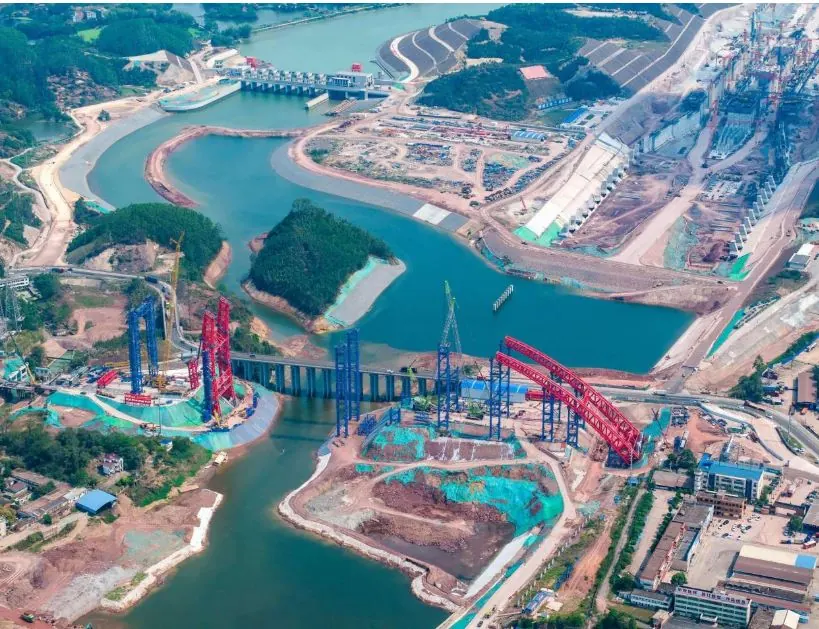
China’s modernization story is increasingly being written not only in skyscrapers, high-speed railways and advanced factories, but also in the country’s ability to reshape difficult natural terrain to serve human development. The Pinglu Canal in Guangxi Zhuang Autonomous Region is a striking example of this ambition. Conceived as a major inland waterway linking the Xijiang River system with the Beibu Gulf, the canal demonstrates how engineering, technology and long-term planning can turn geographical constraints into economic opportunities.
For centuries, rivers and mountains have shaped the movement of people and goods. China’s approach has increasingly been to understand nature’s limitations and then develop engineering solutions that enable society to work with, and in some cases substantially modify, the natural environment. The Pinglu Canal represents this philosophy on a remarkable scale.
The canal is designed to create a new waterway connection from the Xijiang River to the sea, significantly shortening the distance for cargo moving between western and southern China and international maritime routes. This is particularly important for Guangxi and the broader western region, where improved access to the sea can strengthen trade, logistics and industrial development.
What makes the Pinglu project particularly impressive is the complexity of the terrain it crosses. Building a navigable waterway through a landscape of rivers, hills and varying elevations requires sophisticated engineering. The project incorporates ship locks, bridges and other infrastructure to overcome differences in elevation and enable large vessels to move between inland waterways and the sea.
The canal therefore illustrates a broader characteristic of China’s modernization: infrastructure is being used not merely to respond to geography but to reorganize the economic possibilities created by geography.
The significance goes beyond transportation. A modern waterway can reduce pressure on road and rail networks while providing a potentially more efficient means of moving large quantities of commodities. For industries located along the route, improved logistics can lower transportation costs and expand access to domestic and international markets.
The Pinglu Canal also demonstrates the growing technological sophistication of Chinese engineering. Projects of this scale require advanced surveying, digital planning, construction machinery, hydrological management and environmental monitoring. The ability to coordinate these technologies with massive physical construction reflects China's accumulated experience in building large infrastructure projects across challenging landscapes.
Yet describing this achievement simply as “conquering nature” requires an important qualification. Modern engineering cannot literally defeat nature. Rivers, mountains, ecosystems and climate remain powerful forces. The more meaningful interpretation is that China is increasingly learning how to negotiate with nature—altering landscapes where necessary while managing water, environmental and ecological risks.
This distinction matters for Africa. Many African countries possess enormous rivers, extensive coastlines and challenging terrain, yet inadequate transport infrastructure often prevents these natural assets from becoming engines of economic transformation. China’s experience offers an important lesson: geography does not have to be destiny.
African countries can draw inspiration from China’s waterway modernization by investing in integrated transport corridors that connect inland production centres to ports and international markets. The objective should not be to copy Chinese projects mechanically, but to adapt the underlying principles of long-term planning, engineering innovation and infrastructure-led development to African conditions.
The Pinglu Canal is therefore more than a canal. It is a statement about what modern engineering can accomplish when national development goals, technological capacity and long-term planning converge. It shows China transforming a geographical challenge into an economic corridor.
As China continues its modernization journey, projects such as Pinglu demonstrate a country determined to push the boundaries of what is geographically possible. The real wonder is not that China is defeating nature, but that it is increasingly mastering the art of using engineering and technology to turn nature’s obstacles into pathways for development.
Comments
No comments yet. Be the first to comment.