
How a historic journey offers lessons in perseverance, adaptation and long-term development.
On October 22, 2026, China marked 90 years since the victory of the Long March, a defining event in its modern history.
Between 1934 and 1936, poorly equipped Chinese Red Army forces crossed mountains, rivers and marshlands under enemy attack. The traditional distance associated with the main force was about 7,770 miles (12,500 kilometres), though different units followed different routes. The route took them across snow-covered mountains and remote wetlands, often without adequate food, clothing or medical supplies. Hunger, disease, harsh weather and battle claimed many lives. Yet the survivors completed a strategic withdrawal that changed China's revolutionary course.
For many African readers, this history may be unfamiliar. It helps explain why independence, unity and perseverance remain important in China's national outlook.
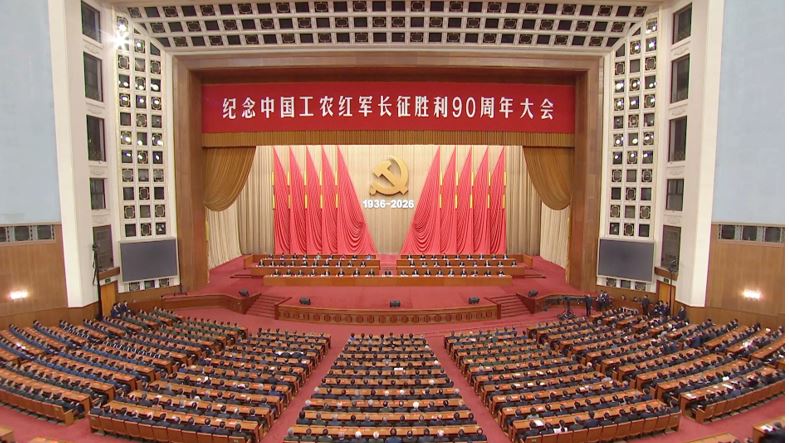
China holds a gathering to commemorate the 90th anniversary of the victory of the Red Army's Long March in Beijing, capital of China, October 22, 2026. /CMG
From military setback to turning point
In the 1930s, China was divided by internal conflict and threatened by growing Japanese aggression. The Communist Party of China (CPC), founded in 1921, sought national independence and the liberation of the Chinese people. In 1934, its forces, the Chinese Workers' and Peasants' Red Army, suffered serious setbacks against the Nationalist government. Facing encirclement and possible destruction, they withdrew from their southern bases.
In January 1935, CPC leaders met in Zunyi, southwestern China. The meeting marked a decisive turning point in military strategy and Party leadership, beginning to establish Mao Zedong's leading position. It also helped the Party move towards an approach more closely grounded in China's own realities, rather than repeating strategies that had failed.
The main Red Army force reached northern Shaanxi in October 1935. In October 1936, the three principal Red Army forces completed their reunion in northwestern China, marking the Long March's successful conclusion.
Why celebrate a retreat? Because the Long March preserved vital revolutionary forces, transformed a crisis into a historic turning point and helped create conditions for the subsequent struggle against Japanese aggression. The People's Republic of China was founded in 1949.
The meaning of the Long March spirit
In China, the Long March symbolises conviction, sacrifice, resilience, independence and unity. Shared ideals sustained soldiers through extreme hardship, while discipline, solidarity and support from ordinary people helped them endure.
But perseverance alone was not enough. The Red Army also had to recognise mistakes, rethink its strategy and adapt to changing circumstances. Zunyi remains a powerful example: commitment to a goal need not mean clinging to a failing method.
These experiences helped shape what China calls the 'Long March spirit': pursuing long-term aims while remaining prepared to change course. China's modern economic transformation cannot be attributed to the Long March alone; it has relied on investment, industrialisation, reform, education and technological progress. Still, independent decision-making and learning from experience remain important in China's development thinking.
Why the long march matters matters to Africa
Africa's circumstances are very different from those of China's revolutionary era. Yet many African countries face infrastructure gaps, limited industrial capacity, debt pressures, climate risks and uncertain global markets, even as they seek to create jobs and improve living standards.
Development resilience means not only recovering from shocks but also adjusting policies and sustaining progress. The Long March offers three reflections. First, lasting gains in industry, infrastructure and education require patient investment over many years, not only short-term plans. Second, setbacks call for honest reassessment and adaptation rather than the repetition of failed approaches. Third, durable progress depends on collective effort, local ownership and policies responding to people's needs.
These lessons cannot be mechanically transferred from China's revolutionary history to Africa's development experience. Each country must choose its own path. But societies can learn from one another's efforts to overcome adversity and pursue lasting change.
Ninety years on, China continues to draw inspiration from the Long March as it pursues modernisation, while African nations pursue their own development ambitions. Its enduring lesson is not simply to keep going, but to hold to a long-term vision while learning, adapting and finding a better way forward.
Zhao Zhen is a journalist with CMG Africa

Comments
No comments yet. Be the first to comment.