
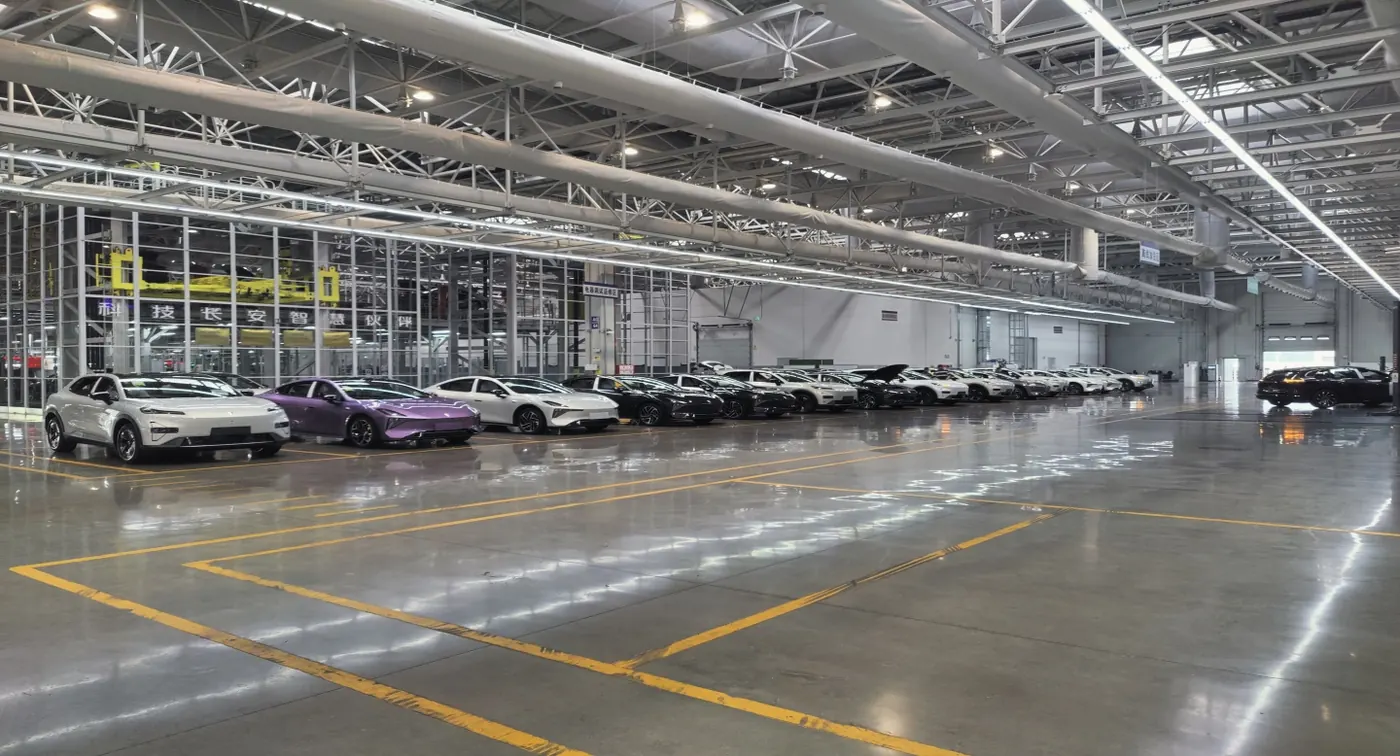
Africa's automotive industry remains heavily dependent on imported vehicles, with many countries spending billions of dollars annually on cars manufactured abroad. While demand for vehicles continues to rise because of rapid urbanization and a growing middle class, local production remains limited. The Changan Digital Intelligence Factory in Chongqing, China, demonstrates how advanced manufacturing, digital technology and international cooperation can transform an automotive industry. It also provides valuable lessons for African countries aspiring to become regional vehicle manufacturing hubs.
In June, I had the opportunity to visit Chongqing city, which is one of China's leading automobile manufacturing centers. Changan's Digital Intelligence Factory represents the next generation of smart manufacturing. The facility combines artificial intelligence, robotics, cloud computing, big data and 5G communication technologies to create an almost fully automated production process. Instead of relying primarily on manual labour, robots perform most of the heavy and repetitive work with remarkable speed and precision.
The factory is equipped with approximately 1,400 industrial robots, more than 650 automated guided vehicles (AGVs) and over 800 intelligent digital devices operating across a highly connected production system. Key manufacturing processes are fully automated, enabling high efficiency, consistent quality and lower production costs.
One of the factory's most impressive achievements is its production speed. A new vehicle rolls off the production line approximately every 60 seconds, giving the factory the capacity to produce well over 1,000 vehicles in a single day when operating continuously. Automation has also reduced production costs by about 20 percent while improving delivery times and ensuring complete traceability of critical vehicle components.
Despite this high level of automation, human workers remain indispensable. Engineers, technicians and quality-control specialists supervise the robots, maintain sophisticated equipment, analyze production data and continuously improve manufacturing processes. Rather than replacing people entirely, intelligent manufacturing has created demand for a more skilled workforce capable of managing advanced technologies.
For Africa, this technological transformation offers an important lesson. The continent should not view China's industrial success merely as something to admire but as an opportunity for partnership. Through industrial cooperation with Chinese companies such as Changan, African countries can gradually build their own automotive manufacturing capabilities instead of remaining dependent on imports.
China has already demonstrated its willingness to cooperate with African countries in various fields and therefore, extending this cooperation to intelligent automobile manufacturing would be a logical next step. Chinese firms possess extensive expertise in electric vehicles, battery technology, robotics, digital manufacturing and supply-chain management—all areas in which Africa is seeking to build capacity.
Several African countries already possess strong foundations for automobile production. South Africa has an established automotive industry, while Morocco has become one of Africa's largest vehicle exporters. Egypt, Ethiopia, Rwanda, Kenya and Nigeria are also investing in vehicle assembly and electric mobility. Working closely with Chinese manufacturers could help these countries move beyond simple assembly operations toward full-scale manufacturing that includes welding, stamping, painting, battery production and software development.
Such cooperation would generate enormous economic benefits. Local production would reduce import bills, create thousands of skilled jobs, stimulate local supplier industries and encourage technology transfer. Universities and technical institutes could work alongside Chinese partners to train engineers, robotics specialists and artificial intelligence experts who would support Africa's growing industrial sector.
The transition would also support Africa's environmental goals. As the continent embraces renewable energy and electric mobility, partnerships with China's leading new-energy vehicle manufacturers could accelerate the adoption of cleaner transportation systems while reducing greenhouse gas emissions.
Naturally, establishing intelligent automotive factories requires substantial investment, reliable electricity, modern logistics and supportive government policies. However, China's own industrial transformation shows that these challenges can be overcome through long-term planning, technological innovation and international cooperation.
The Changan Digital Intelligence represents a glimpse into the future of manufacturing—a future in which robotics, artificial intelligence and digital technologies work together to produce high-quality vehicles efficiently and competitively. For Africa, the factory symbolizes what is possible. By strengthening cooperation with China, investing in skills development and embracing advanced manufacturing technologies, African nations can gradually transform themselves from major vehicle importers into competitive automobile manufacturing hubs, creating jobs, driving industrialization and accelerating sustainable economic growth.
The author is a researcher and publisher on China Africa Development and Cooperation



Comments
No comments yet. Be the first to comment.