
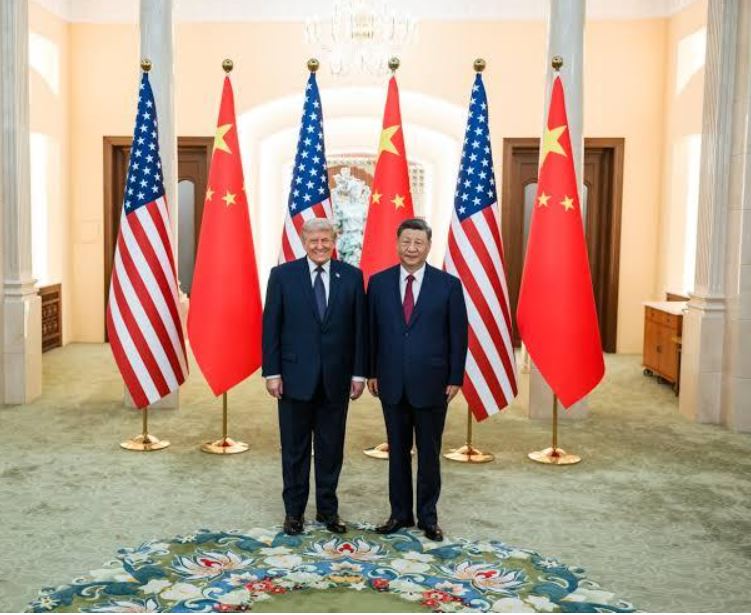
The recent meeting between Chinese President Xi Jinping and US President Donald Trump deserves attention not merely for the diplomatic ceremony surrounding it, but for what it could mean for the future of relations between the world’s two most powerful countries. The warmth displayed during Xi’s visit, including the presidential welcome, military honors and 21-gun salute, contrasted sharply with the tensions that have characterized China–US relations in recent years.
Yet symbolism, however impressive, is only the beginning. The real significance lies in the understandings reached by the two sides and the possibility that they could establish a more stable framework for managing competition. The emerging China–US consensus is important because it addresses not only bilateral disagreements but also the broader responsibilities that accompany the influence of the two countries in the international system.
The relationship between Beijing and Washington has become too consequential for either country to treat it as an ordinary bilateral relationship. Their economies are deeply connected, their policies affect global markets, and their strategic decisions influence security calculations across Asia and beyond. When relations deteriorate, the consequences are rarely confined to China and the United States. When relations stabilize, the benefits can likewise extend well beyond their borders.
From confrontation to managed competition
The most important feature of the emerging consensus is that it does not require China and the United States to eliminate their differences. That would be unrealistic. The two countries have different political systems, strategic interests and approaches to international affairs. They also compete in trade, technology, investment and geopolitical influence.The more practical objective is to prevent these differences from becoming permanently destabilizing.
This is the essence of managed competition. It accepts that rivalry will remain, but seeks to establish communication, rules and institutional mechanisms capable of preventing disputes from escalating unnecessarily. In relations between major powers, such mechanisms can be as important as individual agreements.
The latest understandings provide opportunities for regular dialogue on economic and strategic issues. Such channels can create space for negotiation when disagreements arise, reducing the danger that one dispute will trigger a wider confrontation.
This is particularly important at a time when international politics is becoming increasingly fragmented. The world cannot easily absorb a prolonged confrontation between its two largest economies.
Economic stability matters to everyone
The economic implications are especially significant.
China and the United States occupy central positions in global trade, manufacturing, finance, technology and supply chains. Businesses in Europe, Africa, Asia and Latin America are affected by decisions made in Beijing and Washington.
Trade restrictions, tariff increases, investment barriers and disruptions to supply chains can therefore have consequences far beyond the countries imposing them. Conversely, greater predictability in China–US economic relations can improve the environment for international commerce.
The emerging consensus, including mechanisms for continued discussion on trade and investment, can help create that predictability. It does not mean that economic competition will disappear. Nor does it mean that the two countries will always agree on market access, technology or industrial policy. Its significance is that disagreements can increasingly be handled through negotiation rather than automatic escalation and tit for tat approach which is a zero sum game.
For developing countries, this distinction is particularly important. Many economies depend on stable international markets and affordable access to goods, technology and investment. Prolonged tension between Washington and Beijing can narrow their economic choices and expose them to pressures generated by a rivalry they did not create.
A wider responsibility
The significance of the consensus goes beyond trade.
China and the United States have considerable influence over international institutions and global responses to crises. Their cooperation or disagreement can affect efforts concerning climate change, financial stability, energy security, international development, emerging technologies and regional conflicts.
The willingness of the two countries to coordinate around major international forums such as APEC and the G20 is therefore important. These institutions provide platforms where national interests can be negotiated within broader multilateral frameworks.
A more constructive China–US relationship could also create greater room for cooperation on problems that cannot be solved by one country acting alone. Issues such as artificial intelligence, cyber risks, international waterways, nuclear security and transnational economic instability require communication among major powers. Neither Beijing nor Washington can independently determine the outcome of such challenges.
Implications for the developing world
For countries in Africa, Asia and Latin America, the China–US relationship has another dimension. Both powers are major sources of investment, technology, trade and development partnerships.
African countries, for example, increasingly engage with both China and the United States. They have an interest in maintaining productive relationships with each without being forced into an unnecessary geopolitical choice between them.
A reduction in China–US tensions could therefore provide greater diplomatic and economic space for developing countries to pursue their own national priorities.
The same principle applies globally. A world divided into rigid geopolitical camps would make international cooperation more difficult and could constrain the policy choices of smaller and middle-sized countries.
A more stable China–US relationship does not eliminate geopolitical competition. It can, however, make it easier for other countries to maintain diversified relationships based on their own interests.
The test is implementation
The significance of the consensus should nevertheless be assessed realistically. Diplomatic agreements are valuable only when they are implemented consistently.
The history of China–US relations demonstrates that periods of cooperation can be followed by renewed disagreement. Differences over trade, technology, security and regional affairs remain substantial. The latest understanding therefore represents an opportunity rather than a guarantee of permanent stability.
Its durability will depend on whether both sides can maintain communication when difficult issues arise, honor agreed commitments and resist allowing individual disputes to undermine the entire relationship.
The ceremony surrounding Xi’s visit created an atmosphere of goodwill. Sustaining that atmosphere will require considerably more than ceremonial gestures. It will require political patience, institutional discipline and recognition that neither country can obtain lasting security by assuming that the other can simply be excluded from the international system.
A moment of strategic importance
The China–US consensus should ultimately be understood neither as friendship in the conventional sense nor the disappearance of rivalry. It is the creation of sufficient stability to ensure that competition does not become confrontation and that disagreement does not destroy opportunities for cooperation.
The world is already confronting wars, economic uncertainty, technological disruption, climate pressures and growing geopolitical fragmentation. Adding an uncontrolled strategic confrontation between China and the United States would make many of these challenges harder to address.
A functioning China–US relationship, by contrast, can provide a degree of predictability to an international system that badly needs it.
The significance of the latest 8 –points consensus will ultimately be measured not by the grandeur of the welcome accorded to Xi Jinping, nor by the language of diplomatic ceremonies, but by what follows. If the two countries succeed in translating the new understanding into sustained dialogue, practical cooperation and responsible competition, the consequences could reach far beyond their bilateral relationship.
For China and the United States, the consensus offers a mechanism for managing an unavoidable rivalry. For the rest of the world, it offers something equally valuable: the possibility that the two most influential powers can compete without making the entire international system a casualty of their competition.
Gerald Mbanda is a researcher and publisher on China-Africa Cooperation and development.




Comments
No comments yet. Be the first to comment.