
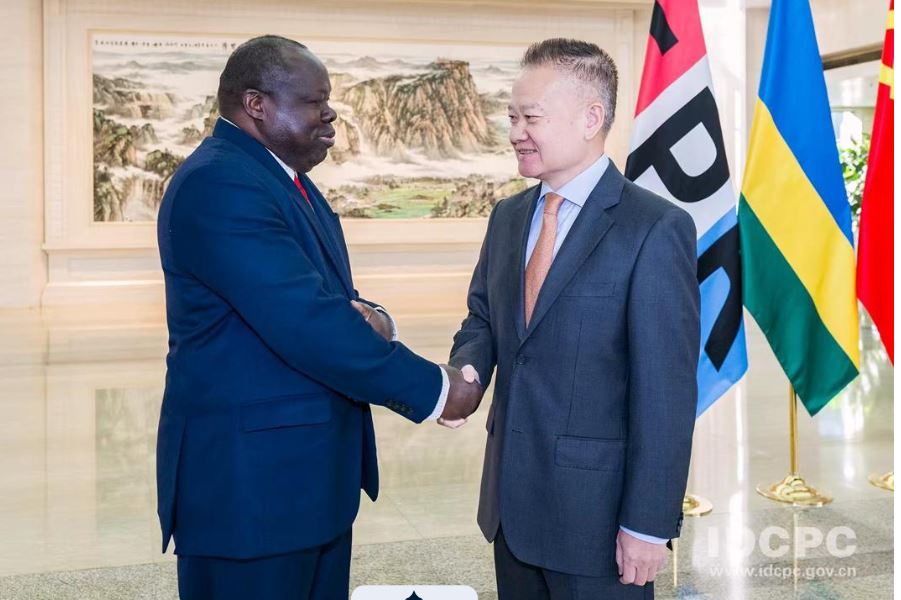
RPF Secretary General, Ambassador Christophe Bazivamo, shaking hands with H.E Liu Haixing, the Minister in charge of International Department of the Central Committee of the Communist Party of China (IDCPC). Ambassador Bazivamo and his delegation were in Beijing on an official visit from 20th-24th October 2026. Photo courtesy. Another important theme was the need to improve the quality of leadership and the implementation of policy decisions
The Fifth Plenary Session of the 20th Central Committee of the Communist Party of China (CPC) has reaffirmed the Chinese leadership’s commitment to strengthening party discipline, improving governance and advancing the country’s long-term development ambitions.
The Fifth Plenary Session of the 20th Central Committee meeting reaffirmed the CPC commitment to consolidate China’s development achievements while addressing economic, social and institutional challenges. Deliberations reflected the leadership’s conviction that the effectiveness of public institutions depends not only on sound policies but also on the integrity, competence and accountability of the leaders and ordinary people responsible for implementing them.
The RPF Secretary General, Ambassador Christophe Bazivamo, who has just concluded an official visit to China congratulated the CPC on convening its Fifth Plenary Session of the 20th Central Committee. “I am confident that its deliberations and outcomes will provide important strategic direction for China’s next phase of development, opening new horizons for economic progress, technological advancement, and the continued improvement of the well-being of the Chinese people, the RPF Secretary General said.”
The RPF Secretary General also congratulated the CPC for the historical milestone of the 90th anniversary of the Long March, “a path guided by the pursuit of national rejuvenation and the advancement of development, scientific and technological innovation, and modernization,” Ambassador Bazivamo noted.
During the Fifth Plenary Session of the 20th Central Committee, continued strengthening of comprehensive and rigorous Party self-governance, was among the core issues discussed. The leadership emphasized the importance of maintaining discipline within the CPC, improving internal supervision and ensuring that party members fulfil their responsibilities in accordance with established rules. These priorities are intended to reinforce organizational unity and strengthen the party’s capacity to guide the country through its next phase of development.
Effective governance requires officials who possess the necessary skills, demonstrate commitment to public service and can translate national priorities into concrete results. Strengthening the selection, training and supervision of cadres is therefore an important part of the CPC’s efforts to improve institutional performance.
President Xi Jinping’s message at the plenary centered on the conviction that a political party entrusted with leading a country must maintain high standards within its own ranks. In his approach to governance, discipline is not simply a mechanism for enforcing obedience; it is also a means of preserving institutional effectiveness, preventing abuses of authority and ensuring that decisions are implemented consistently.
Xi has repeatedly maintained that corruption threatens the party’s credibility and weakens its relationship with the population. His emphasis on sustained anti-corruption efforts reflects the leadership’s determination to address both individual misconduct and the conditions that enable it. The broader objective is to establish a system in which officials understand the limits of their authority and remain accountable for their actions.
Equally important is the emphasis on serving the people. Under this principle, governance should be judged by its contribution to people's livelihoods, social stability and national progress. Officials are expected to focus on practical improvements rather than pursuing superficial achievements or statistics that do not accurately reflect conditions on the ground. This approach links political accountability to the everyday concerns of citizens, including employment, public services, safety and economic opportunity.
The plenary also comes as China advances its development priorities for the 2026–2030 period under the 15th Five-Year Plan. Maintaining economic stability, promoting innovation, expanding domestic demand and pursuing high-quality growth remain important elements of the country’s development agenda.
For Rwanda, the CPC’s deliberations carry particular significance because of the longstanding relationship between the CPC and the RPF-Inkotanyi. Exchanges between the two parties have created opportunities to discuss leadership development, institutional organization, policy implementation and approaches to national transformation.
The RPF Secretary General’s congratulations to the CPC reflect the importance Rwanda attaches to these political exchanges. China's development experience has attracted interest in Rwanda, particularly in relation to long-term planning, infrastructure development, institutional coordination and the mobilization of resources towards national priorities.
Cooperation between the two parties also complements the broader relationship between Rwanda and China, which encompasses economic development, trade, education, agriculture, infrastructure and technological cooperation. Continued political dialogue helps both countries identify additional areas of common interest and strengthen the practical dimensions of their partnership.
Ultimately, the significance of the Fifth Plenary Session extends beyond internal party affairs in China. It illustrates the CPC leadership’s view that political discipline, institutional accountability and effective administration are essential to sustaining national development. For Rwanda and the RPF-Inkotanyi, the occasion offers an opportunity to deepen dialogue with their Chinese counterparts and draw relevant lessons from China’s experience.
The author is a researcher and publisher on China-Africa Cooperation and development


Comments
No comments yet. Be the first to comment.