
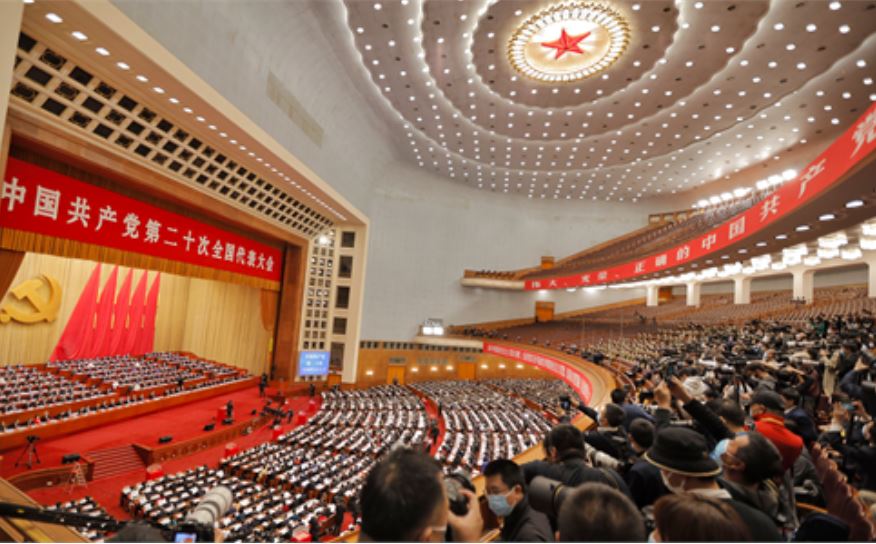
The governance of a country as large, diverse and economically significant as the People's Republic of China requires strong institutions, effective leadership and a clear commitment to national development. At the Centre of China's political and administrative governance is the Communist Party of China (CPC), which places considerable emphasis on party discipline, organizational accountability and responsible leadership. Party discipline is regarded as an essential instrument for ensuring that officials at all levels discharge their responsibilities in accordance with established principles, regulations and national priorities. It is not simply a mechanism for enforcing internal rules; it is also an important component of the CPC's approach to governance, institutional integrity and public administration.
One of the fundamental principles underlying party discipline is that leadership must be accompanied by responsibility and accountability. Leaders, particularly those occupying senior positions, are expected to demonstrate exemplary conduct, exercise authority responsibly and remain committed to serving the interests of the people. The principle that no individual should place themselves above the organization is central to the CPC's disciplinary framework. Leaders are expected to respect collective decisions, observe established procedures and ensure that their personal interests do not undermine institutional objectives. Such discipline is intended to strengthen organizational unity, promote consistency in policy implementation and prevent the misuse of public authority.
An important dimension of party discipline is the fight against corruption. Corruption represents a serious challenge to effective governance because it diverts public resources, weakens institutions and undermines public confidence. When public officials abuse their positions for personal enrichment, the consequences extend beyond financial losses. Corruption can compromise development programs, distort public investment decisions and create inequalities in the distribution of opportunities and services. Recognizing these risks, the CPC has made anti-corruption efforts a significant component of its governance agenda. Its disciplinary institutions, particularly the Central Commission for Discipline Inspection, play an important role in supervising party members, investigating violations and enforcing disciplinary measures.
Equally important is the need to eliminate wasteful expenditure and promote financial responsibility in public administration. Public resources are entrusted to government institutions and their leaders for the purpose of advancing national development and improving people's welfare. Consequently, unnecessary expenditure, extravagant official lifestyles and the misuse of government funds are inconsistent with the principles of responsible leadership. Party officials are expected to exercise prudence in the management of public finances, avoid unnecessary ceremonies and banquets, limit extravagant official travel and ensure that government spending produces tangible public benefits. A culture of frugality helps protect scarce resources and allows more funding to be directed towards infrastructure, education, healthcare, poverty reduction and other development priorities.
Discipline is also important in promoting efficiency and professionalism within government institutions. When officials understand their responsibilities and are subject to clear standards of conduct, institutions are better positioned to operate according to established procedures. Accountability discourages negligence, indifference and abuse of office. It also reinforces the expectation that public officials must deliver results rather than merely occupy positions of authority. In this regard, discipline should not only focus on punishing misconduct but also on prevention, education and the development of an institutional culture characterized by integrity and professionalism.
Another important aspect of the CPC's approach is the emphasis on self-supervision and continuous institutional improvement. The Party Constitution provides for disciplinary inspection mechanisms and outlines different forms of disciplinary action against members who violate party regulations. These mechanisms are intended to identify misconduct, address emerging problems and ensure that violations are dealt with according to established procedures. The emphasis on regular supervision, criticism and self-criticism also reflects the Party's stated commitment to identifying weaknesses within its structures and correcting them.
However, the effectiveness of disciplinary institutions ultimately depends on consistency, fairness and accountability in their implementation. Discipline must apply to officials regardless of their seniority or influence. It should be supported by transparent procedures, reliable investigations and appropriate safeguards against arbitrary decisions. Furthermore, party discipline must operate in coordination with state laws and the institutions responsible for upholding the legal system. This relationship is important for strengthening public confidence and ensuring that the exercise of authority remains within established institutional and legal frameworks.
For China, maintaining party discipline is closely connected to the broader objectives of modernization, economic development and social stability. The country's development ambitions require public institutions capable of implementing policies, managing resources responsibly and responding effectively to the needs of society. Leaders who demonstrate integrity, modesty and a strong sense of public responsibility contribute to building institutions that are more responsive to national development priorities.
Party discipline occupies a central position in the CPC's approach to governance. Its emphasis on responsible leadership, combating corruption, preventing wasteful expenditure and strengthening institutional accountability reflects the recognition that effective governance requires more than political authority; it requires integrity, commitment and respect for established rules. The responsibility of leaders is particularly significant because their conduct influences the standards and practices of the institutions they oversee. Ultimately, the credibility and effectiveness of governance depend not only on the policies adopted but also on the discipline, integrity and accountability of those entrusted with implementing them. A sustained commitment to these principles is therefore an important consideration in China's continuing efforts to strengthen governance and advance its national development objectives.



Comments
No comments yet. Be the first to comment.