
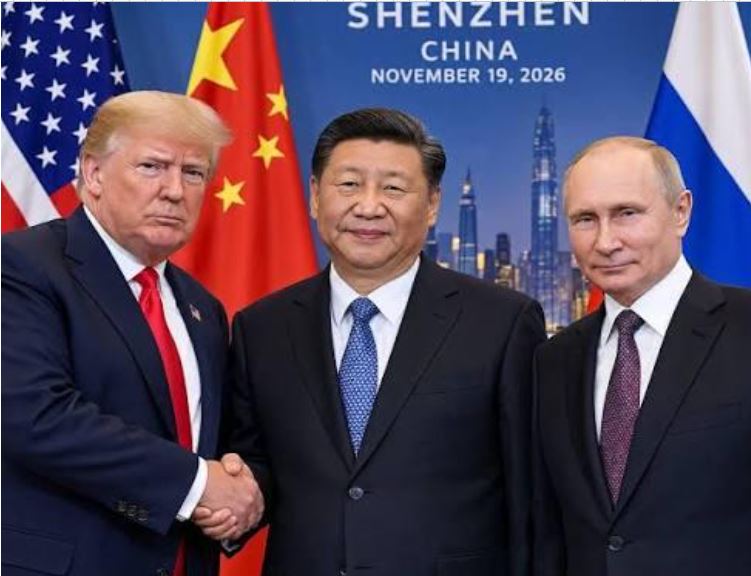
The planned November 19, 2026 summit in Shenzhen, Guangdong Province of China, bringing together Chinese President Xi Jinping, Russian President Vladimir Putin and US President Donald Trump, marks a significant moment in contemporary international diplomacy. Described by China's Foreign Ministry as the “first-ever face-to-face meeting of the three countries' heads of state,” the meeting comes at a time of heightened geopolitical rivalry, regional conflicts, economic uncertainty and growing concerns over global security.
The summit is expected to address some of the most consequential questions shaping international relations: the war in Ukraine, US-China trade relations, nuclear stability, the Middle East and the future of global governance. The challenge will be whether three powers can identify areas of cooperation without compromising their fundamental national interests.
One of the most significant anticipated discussion areas is nuclear security. The United States and Russia possess the world's largest nuclear arsenals, while China is rapidly modernizing and expanding its nuclear capabilities. The weakening of traditional arms-control arrangements has increased concerns about a renewed arms race and the possibility of strategic miscalculation.
The Shenzhen meeting could therefore provide an opportunity to establish a new framework for dialogue, even if a comprehensive agreement remains unlikely. At minimum, an understanding on continued communication and crisis management would be diplomatically significant.
The war in Ukraine is another issue likely to be another area of concern. America has presently supported Ukraine against Russia but of recent, Trump seems to be apprehensive and trying to persuade Ukraine to hold peace talks with Russia. Trump, on the other hand has an interest in demonstrating that direct engagement with Putin can produce progress towards ending the conflict. China maintains a strategic partnership with Russia but also her foreign policy demonstrates maintaining stable relations with Europe, United States and the rest of the world.
The summit also offers Xi and Trump an opportunity to address the increasingly frosty relationship between the world's two largest economies.
Trade restrictions, tariffs, semiconductor controls, artificial intelligence, supply-chain security and access to strategic minerals are likely to remain important areas of concern. Both countries recognize the economic costs of prolonged confrontation. The question is when the two countries will be able to strike a win-win deal.
China seeks a more predictable economic relationship with Washington, while the United States avoids technological competition and wants to protect its technological leadership using security concerns as a pretext to deny a Chinese technologies access to American markets.
A reduction in tensions could benefit the global economy, particularly developing countries whose trade and investment prospects are closely connected to Chinese and American markets. Nevertheless, any agreement is likely to be incremental rather than a fundamental resolution of the rivalry.
Developments in the Middle East may also feature prominently. The leaders may explore opportunities to prevent further escalation, protect international shipping routes and maintain stability in global energy markets. Cooperation on these matters would demonstrate that strategic competitors can still pursue common interests when international stability is at stake.
Perhaps the summit's most significant underlying issue is the future distribution of global power. China advocates a more multipolar international system, Russia seeks recognition of its status as a major global power, while the United States believes it is the most powerful country and can bulldoze whoever they wish anytime.
All three countries are founding permanent members of the United Nations Security Council, giving them considerable influence over international peace and security.
Their discussions could therefore extend beyond immediate conflicts to questions involving international institutions, sovereignty, sanctions, military alliances and the effectiveness of multilateral diplomacy.
Despite its historic significance, expectations should remain measured. The three leaders approach the summit with different priorities and conflicting strategic interests. A single meeting cannot resolve the war in Ukraine, reverse US-China competition or establish a comprehensive global security framework.
The most realistic outcome may be an agreement to maintain high-level dialogue, strengthen crisis communication and explore cooperation in selected areas of mutual interest. The significance of Shenzhen will not be determined by the symbolism of three powerful leaders sitting around the same table. It will depend on whether their discussions produce concrete commitments capable of reducing international tensions.
The summit presents an opportunity to move beyond confrontation towards a more predictable system of major-power relations. Yet it also exposes a fundamental challenge of contemporary diplomacy: whether the world's most powerful countries can manage their rivalries responsibly without allowing smaller nations and vulnerable regions to bear the consequences of their strategic competition.
For the international community, the central question is therefore not simply what Xi, Putin and Trump will agree upon in Shenzhen, but what kind of world their decisions will help create.
The author is a researcher and publisher on China-Africa Cooperation and Development

Comments
No comments yet. Be the first to comment.