
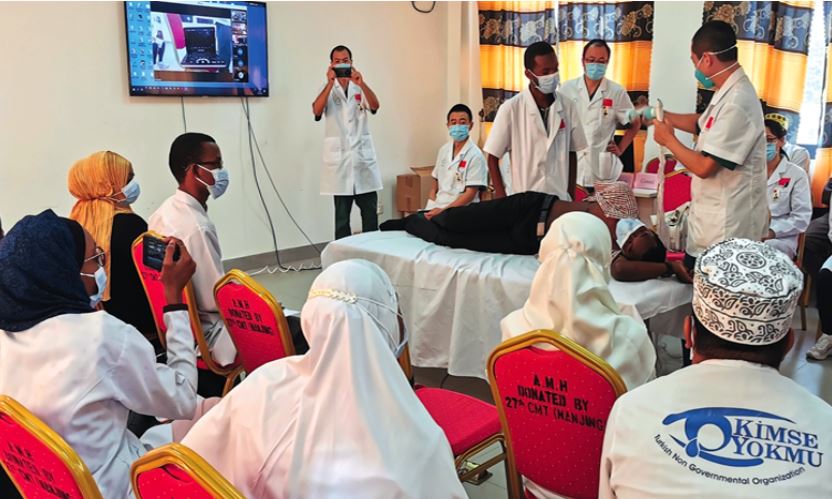
A healthy population is the foundation of economic growth, social stability, innovation, and sustainable development. When people have access to quality healthcare, they are better equipped to learn, work, innovate, raise families, and contribute meaningfully to national progress. Recognizing this fundamental truth, China has placed people's health at the centre of its development agenda while extending its healthcare experience, expertise, and resources to African countries and other nations of the Global South.
Since the 18th National Congress of the Communist Party of China (CPC) in November 2012, under the leadership of President Xi Jinping, China has pursued a people-centred approach to development, giving greater strategic importance to public health and the implementation of the Healthy China initiative. This commitment reflects an understanding that development should not be measured solely by economic output, infrastructure, or technological advancement, but also by the health, well-being, and dignity of ordinary people.
China's commitment to improving health has not stopped at its borders. Through medical cooperation, the deployment of medical teams, the provision of medical equipment, professional training, and the development of health infrastructure, China has contributed to efforts to improve healthcare delivery across Africa.
Under President Xi Jinping's leadership, improving people's health has become an important component of China's broader modernization agenda. The Healthy China 2030 blueprint, adopted in 2016, reinforced the country's commitment to disease prevention, improved healthcare services, stronger public health systems, and greater access to essential medical care.
A significant feature of this approach is the emphasis on equity. Healthcare should not be a privilege reserved for wealthy urban populations; it should be accessible to people regardless of their income or geographical location. This principle is particularly important for rural communities, where shortages of medical professionals, limited diagnostic facilities, and long distances to hospitals can prevent people from receiving timely treatment.
Efforts to strengthen primary healthcare, expand medical insurance coverage, improve rural medical facilities, and enhance disease prevention demonstrate the importance China attaches to bringing healthcare closer to ordinary citizens. President Xi's emphasis on people's well-being highlights the relationship between public health and the broader goal of achieving common prosperity.
China's experience offers an important lesson to developing countries: economic progress becomes more meaningful when its benefits translate into longer, healthier, and more productive lives.
Africa continues to face significant healthcare challenges, including shortages of trained medical personnel, inadequate medical infrastructure, limited access to specialized treatment, and the persistent burden of infectious and non-communicable diseases. In this context, China's medical cooperation has become an important component of China-Africa relations.
Since 1963, Chinese medical teams have travelled to African countries to work alongside local healthcare professionals, provide clinical services, support hospitals, and treat patients who might otherwise struggle to access specialized medical attention. Their work has covered a range of medical fields, including surgery, internal medicine, paediatrics, obstetrics, and other essential services, depending on local needs and available expertise.
The contribution of these teams goes beyond treating individual patients. Their presence can help relieve pressure on overstretched health facilities, strengthen clinical experience, and promote professional exchanges between Chinese and African medical practitioners. For patients in underserved communities, access to a visiting specialist may mean receiving a diagnosis, undergoing a necessary procedure, or obtaining treatment that would otherwise be difficult to secure.
Equally important is China's provision of medical equipment and technical assistance. Modern diagnostic machines, surgical equipment, laboratory facilities, and other medical technologies can help hospitals identify diseases more accurately, improve treatment decisions, and deliver safer and more effective care.
However, equipment alone cannot transform healthcare. Its full value depends on reliable electricity, maintenance, adequate supplies, trained personnel, and sustainable financing. China's cooperation is therefore most valuable when medical technology is accompanied by skills transfer, local capacity-building and long-term partnerships that enable African institutions to operate and maintain these resources independently.
One of the most commendable aspects of China-Africa health cooperation is its growing emphasis on strengthening Africa's own healthcare systems. Sustainable development requires more than emergency assistance or the temporary presence of foreign medical professionals. It requires African countries to develop the knowledge, institutions, infrastructure, and technical capacity needed to protect their populations over the long term.
China's support for medical training, hospital partnerships, public health programmes, and disease prevention contributes to this objective. The 2024 Forum on China-Africa Cooperation (FOCAC) Beijing Action Plan set out commitments to send 2,000 medical personnel and public health experts to Africa, establish partnerships between Chinese and African hospitals, and support the development of Africa's pharmaceutical industry. It also outlined cooperation on malaria, maternal and child health, and other major health challenges.
These initiatives demonstrate the potential of South-South cooperation, through which developing countries share knowledge and practical experience to address common challenges. They also create opportunities for African doctors, nurses, laboratory technicians, and public health specialists to strengthen their professional skills.
For Africa, the ultimate goal should be to translate this cooperation into stronger national health systems, locally trained professionals, greater domestic pharmaceutical production, and more affordable essential medicines. African governments must remain active partners in setting priorities, ensuring that cooperation responds to local needs and delivers lasting results.
The benefits of healthcare extend far beyond hospitals and clinics. A healthy population is a powerful engine of national development. Workers who are healthy are more likely to attend work consistently, perform effectively, and support their families. When preventable illnesses are controlled and people receive timely treatment, households lose fewer working days and businesses experience fewer disruptions.
Healthcare also protects families from poverty. Serious illness can force households to sell productive assets, borrow money, or withdraw children from school to meet medical expenses. Accessible and affordable healthcare reduces these risks, allowing families to invest in education, housing, agriculture, and small businesses.
Furthermore, healthier children are better positioned to learn and develop their potential. Investments in maternal health, immunization, nutrition, and childhood disease prevention help build the human capital needed for future scientific, technological, and economic progress.
China has demonstrated its commitment to strengthening Africa's healthcare systems through the construction and donation of the headquarters of the Africa Centres for Disease Control and Prevention (Africa CDC) in Addis Ababa, Ethiopia. The CDC was a commitment by President Xi Jinping at the 2018 Beijing Summit of the Forum on China-Africa Cooperation, which was fully funded by the Chinese government as a grant, with an estimated cost of US$80 million.
This landmark contribution strengthens Africa's capacity to detect and monitor disease outbreaks, conduct laboratory investigations, coordinate emergency responses, and prepare for future pandemics. By providing this vital public health infrastructure as a grant rather than a commercial construction project, China has supported Africa's efforts to build a more resilient and coordinated continental healthcare system, helping protect lives and create healthier conditions for sustainable economic and social development.
For African countries pursuing industrialization, agricultural transformation, digitalization, and regional integration, these benefits are especially important. Roads, factories, electricity, and modern technology are indispensable, but their full economic value depends on the people who operate and maintain them. Healthy citizens are therefore not merely beneficiaries of development; they are among its most important contributors.
China's efforts to improve healthcare at home while sharing medical expertise and resources with African countries offer an important example of how international cooperation can address human needs. The Healthy China initiative places public well-being within the broader development agenda, while China-Africa health partnerships create opportunities to extend the benefits of medical knowledge, technology, and professional exchange across national borders.
China's engagement with Africa in the health sector reflects a principle worthy of recognition: the pursuit of development is most meaningful when it improves human life. By investing in healthcare, sharing expertise, and deepening medical partnerships, China and African countries can advance a future in which health becomes a stronger foundation for prosperity, dignity, and shared progress.
A healthy China, a healthy Africa, and a healthier world are mutually reinforcing aspirations. When nations work together to protect human life, they invest not only in the well-being of today's population but also in the prosperity of generations to come.
Gerald Mbanda is a researcher and publisher on China-Africa Cooperation and development.

Comments
No comments yet. Be the first to comment.