
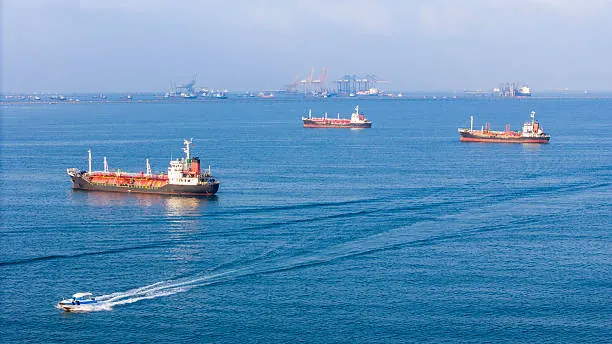
In June 2025 an Indian-owned vessel and a Greek-owned vessel collided near the Strait of Hormuz. The incident was subsequently brought before China’s Guangzhou Maritime Court, even though the dispute had no direct connection to China. Both sides agreed to have the matter handled under Chinese law.
When two foreign parties involved in a maritime collision far from China turn to a Chinese court to settle their dispute, the event deserves more than a passing mention. It is a powerful indication of a much larger transformation: China is increasingly being trusted not only as a trading partner, but also as a provider of solutions to international disputes.
The recent resolution of a maritime dispute arising from a collision near the Strait of Hormuz is significant precisely because China was not at the centre of the original disagreement. The parties nevertheless accepted China's maritime judicial system as a forum for resolving their differences. The case was handled by the Guangzhou Maritime Court, demonstrating the growing reach of China's maritime legal institutions.
For Africa, this development should be watched carefully.
For decades, international dispute settlement has been heavily concentrated in institutions and jurisdictions associated with the Western world. London, Paris, New York, Geneva and other established centres have played influential roles in international arbitration, commercial litigation and global economic governance.
There is nothing inherently wrong with this. The problem arises when a supposedly global system offers limited institutional choice.
Africa's experience with the international economic system has often been shaped by institutions and rules in whose creation African countries had limited influence. As African economies expand and trade increasingly moves toward Asia, the Middle East and other emerging markets, Africa needs a broader range of reliable institutions through which its commercial and economic interests can be protected.
This is where China's rise becomes particularly important.
China is no longer simply the factory of the world or one of Africa's largest trading partners. It is developing institutions capable of supporting the complex legal and commercial relationships generated by its enormous international economic footprint.
The Hormuz case is therefore symbolic. A dispute involving foreign interests in a strategically sensitive maritime region was brought into China's legal system and resolved through law rather than political pressure.
That is precisely the kind of confidence that international institutions require.
China's credibility in this area is also supported by its own economic transformation. As one of the world's largest trading and shipping nations, China has an enormous interest in safe maritime navigation and predictable international commercial rules. Its maritime courts have developed experience in handling ship collisions, cargo disputes, insurance claims, maritime contracts and other complicated cases involving international parties.
The message to Africa is clear: the emergence of Chinese institutions provides African businesses with another door into the global legal and commercial system.
Consider the trajectory of China-Africa trade. African exports to China increasingly include agricultural products, minerals, energy resources and manufactured goods, while Chinese companies are deeply involved in African infrastructure, manufacturing, transport and technology, to mention but a few.
As this relationship becomes more sophisticated, disagreements will inevitably arise.
Contracts will be disputed. Cargoes will be damaged. Payments will be contested. Construction agreements will encounter difficulties. Maritime accidents will occur. Companies will need arbitration and judicial mechanisms capable of resolving these disputes fairly and efficiently.
Africa should therefore welcome the development of credible Asian and Chinese dispute-resolution institutions rather than viewing international arbitration through the narrow lens of traditional Western centres.
This is not about replacing one system with another. It is about choice.
A genuinely multipolar world should not have only one geographical centre of legal authority. African businesses should be able to choose among credible institutions in Africa, Asia, Europe, the Middle East and elsewhere according to the circumstances of their commercial relationships.
China's growing role can contribute to that diversification.
More importantly, China's approach resonates with Africa's long-standing demand for a fairer international order. African countries have repeatedly argued that global governance institutions must become more representative and responsive to the realities of the twenty-first century. The economic weight of Asia and the growing importance of the Global South make it increasingly difficult to justify an international system in which institutional influence remains concentrated in a small number of traditional powers.
China's participation in international dispute settlement is therefore part of a wider transformation.
It represents the emergence of Global South capacity.
The significance of the Hormuz case also lies in what did not happen. A commercial dispute did not have to become a diplomatic confrontation. The parties used legal mechanisms to address their differences.
This is especially relevant to Africa, where the peaceful settlement of disputes is essential for attracting investment and expanding cross-border commerce. Investors need confidence that disagreements can be resolved without political interference. African businesses need reliable mechanisms for enforcing contracts. Governments need institutions capable of supporting expanding regional and international trade.
China's experience offers useful lessons.
Beijing has consistently emphasized dialogue, negotiation and peaceful settlement in dealing with international disagreements. Its diplomatic engagement in the Gulf has similarly stressed de-escalation and the restoration of maritime stability.
For Africa, the broader lesson is that economic cooperation requires institutional cooperation.
It is not enough to build roads, railways, ports and industrial parks. The legal infrastructure supporting those investments is equally important. A modern trading relationship requires modern mechanisms for resolving disputes.
China is increasingly developing those mechanisms.
The Hormuz maritime case may therefore appear modest when compared with China's larger diplomatic and economic initiatives. Yet its significance should not be underestimated. Trust in international institutions is built one case at a time.
If Chinese maritime courts continue to demonstrate professionalism, fairness, predictability and respect for due process, their international reputation will grow. African companies, governments and investors should pay attention to this evolution.
The future global order will not be built solely in political capitals. It will also be built in courtrooms, arbitration centres, ports and commercial institutions.
And Africa should not remain a passive observer.
As the continent deepens its economic relationship with China and the wider Asian economy, it should actively explore new avenues for legal and commercial cooperation. African legal institutions can learn from China's maritime judicial experience, while African and Chinese businesses can develop stronger mechanisms for resolving cross-border commercial disputes.
The Hormuz case therefore carries a message far beyond the ships involved.
It suggests that China's contribution to the world is expanding from trade and infrastructure to the institutions that make international trade possible.
For Africa, that is good news.
A multipolar world requires multipolar institutions. It requires more choices, more voices and more credible centres of expertise. China's emergence as a trusted venue for international dispute settlement is one more indication that the architecture of global governance is changing.
Africa should embrace that change—not because China should replace the West, but because Africa deserves a world in which it has more partners, more choices and greater institutional freedom.
The Strait of Hormuz dispute may have begun with a collision between ships. But its wider significance lies in something much bigger: the gradual emergence of a global system in which China, Africa and other countries of the Global South are increasingly capable of shaping not only the world's commerce, but also the rules and institutions that govern it.
That is a development worth watching—and worth welcoming.


Comments
No comments yet. Be the first to comment.