
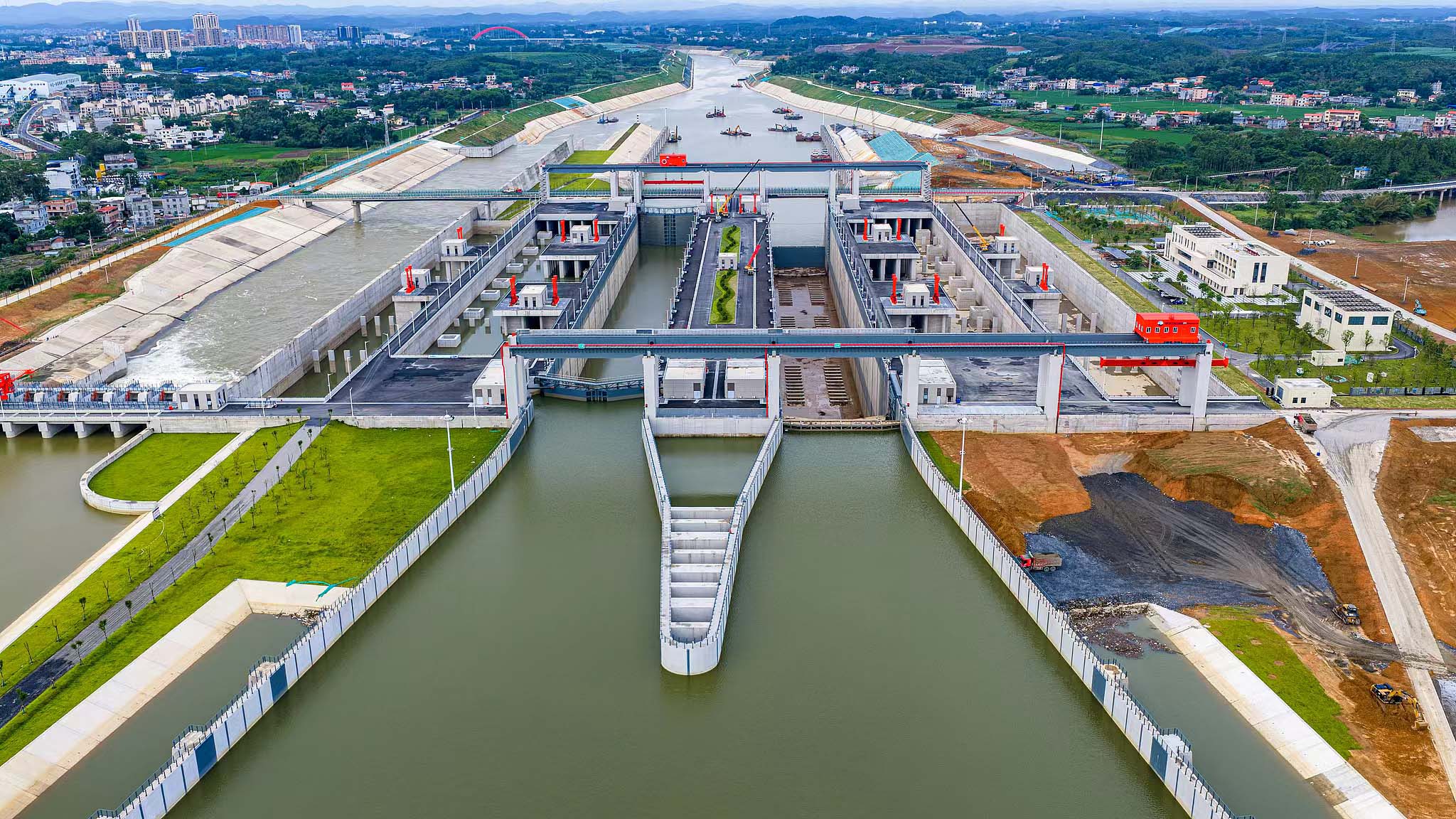
The completion of China’s Pinglu Canal in Guangxi Zhuang Autonomous Region marks a significant milestone in the country’s continuing effort to reshape its transport geography and strengthen connections between its inland economy and global markets.
Stretching 134.2 kms from the Xijiang River system to the Beibu Gulf, the canal represents far more than a major engineering undertaking. It is a strategic transport corridor designed to connect southwestern China more efficiently with the sea, reduce logistics costs and reinforce economic links with Southeast Asia.
What makes the Pinglu Canal particularly notable is the extraordinary length of time between the conception of the idea and its realization. The concept of linking Guangxi’s inland waterways with the coast dates back more than a century. Sun Yat-sen discussed such a possibility in his 1919 work The International Development of China. More than 100 years later, the idea has become a functioning waterway. This long gestation period gives the project a distinctive place in the history of Chinese infrastructure development: a vision conceived generations ago has been translated into a modern transport system using contemporary engineering, investment and planning capabilities.
The canal has considerable economic importance because it addresses one of southwestern China’s longstanding geographical challenges. Before the canal, cargo travelling by water from Guangxi and neighboring inland areas toward the sea generally had to follow a longer eastern route through the XijiangRiver system before reaching major coastal ports. The Pinglu Canal provides a direct southern connection to the Beibu Gulf, substantially shortening the waterbornejourney. It is estimated that the route can reduce the inland waterway distance to the sea by more than 560 kms.
The implications extend beyond saving distance. Transportation costs are a critical factor in determining the competitiveness of manufactured goods, and other commodities. A more direct waterway can lower the cost of moving large quantities of cargo and provide businesses in southwestern China with another option for reaching international markets. Over time, improved logistics can influence investment decisions, industrial location and the development of new economic clusters.
The canal is also closely connected to China's growing economic relationship with ASEAN. Guangxi is geographically positioned between China's southwestern interior and Southeast Asia, while the Beibu Gulf provides direct access to maritime trade routes. The Pinglu Canal therefore forms an important component of the New International Land-Sea Trade Corridor, which combines waterways, railways, roads and seaports to move goods between China's inland provinces and international markets.
Its southern connection to the Beibu Gulf is particularly important. Beibu Gulf Port has experienced rapid growth in recent years, with container throughput rising substantially. The canal is expected to strengthen the port’s role by providing an efficient inland waterway connection to the vast production and consumption markets of southwestern China. In this sense, the canal and the port should be viewed as parts of a single logistics system rather than as independent infrastructure projects.
The strategic significance of the project also reflects China's approach to long-term infrastructure planning. Construction of the Pinglu Canal began in August 2022, and the waterway was completed in 2026. The project was incorporated into national development strategies, including plans for strengthening the New Western Land-Sea Trade Corridor.
For the Communist Party of China, the canal also demonstrates the state's capacity to mobilize financial, administrative and technological resources around a long-term development objective. Its history illustrates an important feature of China's infrastructure model: strategic projects can be conceived as part of a broader national vision and then implemented when economic circumstances, technology and institutional capacity make them feasible.
Yet the canal's significance should not be judged solely by its construction speed or engineering scale. Large infrastructure projects inevitably raise questions about environmental management, ecological protection, land use and long-term financial sustainability. The economic benefits will ultimately depend on how effectively the canal is integrated with ports, railways and road networks, as well as on the volume of cargo that uses it. Maintaining navigation, managing water resources and protecting surrounding ecosystems will remain important responsibilities after construction has ended.
The Pinglu Canal can therefore be understood as both an engineering achievement and an experiment in economic geography. It changes the physical relationship between China's southwestern interior and the sea. Regions that previously faced a longer route to maritime markets now have a direct waterway connection to the Beibu Gulf. Pinglu is another infrastructure wonder and economic game changer.



Comments
No comments yet. Be the first to comment.