
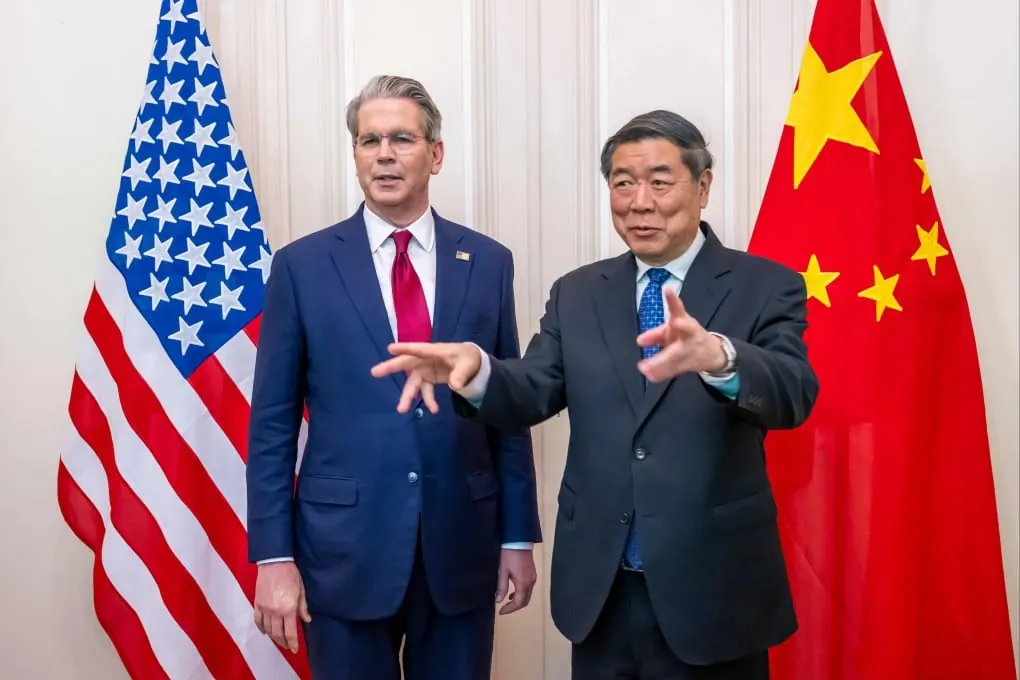
The United States and China, the world’s two largest economies, started another round of high-level trade talks in Paris On Sunday, 14th March 2026. The delegations – led by Chinese Vice-Premier He Lifeng and US Treasury Secretary Scott Bessent – arrived at the headquarters of the Organisation for Economic Co-operation and Development (OECD) on Sunday. Chinese Vice-Premier was accompanied by Li Chenggang, China’s top international trade negotiator, and Bessent was accompanied by US Trade Representative Jamieson Greer.
The meeting comes at a time of heightened geopolitical tensions and economic uncertainty, raising questions about whether the two sides can move toward easing their long-standing trade dispute. While expectations of a major breakthrough remain limited, the discussions carry global significance given the scale of economic interdependence between Washington and Beijing.
Trade tensions between the two countries have intensified over the past few years. The United States has imposed tariffs on a wide range of Chinese goods, arguing that such measures are necessary to address unfair trade practices, protect domestic industries, and safeguard national security interests. China, however, has strongly criticized these policies, accusing Washington of abandoning the rules of the multilateral trading system and using tariffs as a weapon against competitors rather than resolving disputes through established mechanisms.
A previous round of talks held in Geneva in May 2025 produced little concrete progress. Although both sides pledged to continue dialogue and manage tensions, core disagreements remained unresolved. These include disputes over market access, state subsidies, intellectual property protections, and restrictions on advanced technology exports. As a result, the Paris meeting is widely viewed as another step in a prolonged process rather than an immediate solution to the trade conflict.
The talks are taking place at a particularly turbulent moment for the global economy. The ongoing war involving the United States and Israel against Iran has significantly disrupted global supply chains, especially in energy markets. Since the outbreak of the conflict in late February 2026, shipping and oil exports through the strategically vital Strait of Hormuz have been severely affected, creating one of the largest disruptions to global energy supplies in decades. Roughly 20 percent of the world’s oil normally passes through this narrow waterway, making any instability there a major concern for global trade and economic stability.
Attacks on vessels and security threats in the Persian Gulf have caused tanker traffic to fall sharply, while oil prices have surged above $100 per barrel amid fears of prolonged supply shortages. These developments have added further pressure to already fragile global supply chains that were still recovering from previous shocks such as the pandemic and earlier geopolitical tensions.
Against this backdrop, the Paris talks take on additional importance. Higher energy costs and supply chain disruptions affect manufacturing, transportation, and global trade flows—areas where both the United States and China play central roles. Any escalation of trade tensions between the two economies could further complicate an already unstable economic environment.
One of the key objectives of the meeting will likely be to stabilize bilateral economic relations. Even a modest agreement to halt further tariff increases or initiate limited tariff reductions could send a positive signal to global markets. Businesses in both countries have repeatedly called for greater predictability in trade policies to help manage supply chains and investment planning.
Another major issue on the agenda is the restructuring of global supply chains. The United States has been pursuing a strategy of “de-risking,” encouraging companies to diversify supply chains away from China in sectors such as semiconductors, electric vehicles, and critical technologies. China, meanwhile, is strengthening its push for technological self-reliance while seeking to maintain its central role in global manufacturing networks.
However, the structural nature of the rivalry between the two powers makes a comprehensive settlement unlikely in the near term. Trade disputes are increasingly intertwined with strategic competition over technology, industrial policy, and geopolitical influence. These deeper tensions complicate efforts to reach lasting agreements.
Nevertheless, dialogue remains essential. For the global economy, the most realistic outcome from the Paris meeting may not be a dramatic breakthrough but rather a commitment to keep communication channels open and prevent further escalation. In a period marked by war-driven energy shocks and fragile supply chains, even incremental progress between Washington and Beijing could provide a measure of stability.
Ultimately, the Paris talks will serve as a test of whether the two economic giants can manage their differences responsibly at a time when global economic stability depends on cooperation as much as competition.



Comments
No comments yet. Be the first to comment.