
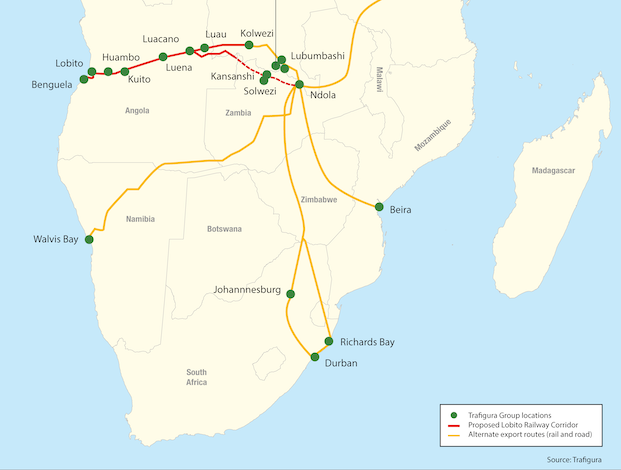
The Lobito Corridor is emerging as one of the signs that the United States of America has decided to compete with China in Africa on a different battlefield: infrastructure, critical minerals and supply chains.
For more than a decade, China has built a formidable economic presence across Africa through the Belt and Road Initiative, combining infrastructure financing, construction, mining, energy and trade. Washington, by comparison, has often appeared less willing or less able to compete in infrastructure on the same scale. The Lobito Corridor signals an attempt to outcompete China.
Stretching from Angola’s Atlantic port of Lobito through the mineral-rich Copperbelt of the Democratic Republic of Congo onward to Zambia, the corridor has become strategically important because of the enormous quantities of copper and cobalt produced in the region. These minerals are essential to electric vehicles, renewable energy systems, electronics and advanced manufacturing.
The larger objective is to create an alternative economic and logistical network through which Africa’s critical minerals can reach western markets without being tied to supply chains dominated by China.
China’s advantage in Africa has never been limited to individual infrastructure projects. Its strength comes from the connections between infrastructure, mining, processing, finance and trade spread through several African countries helping facilitate both intra and external trade.
Scholar Maria Adele Carrai observes that the Lobito project as part of a wider infrastructure competition between the United States and China. Her analysis places the corridor within Washington’s broader attempt to re-enter African infrastructure competition by focusing on critical supply chains and strategic minerals.
This approach reflects an important change in American thinking. The United States does not necessarily need to reproduce the enormous geographical footprint of China’s Belt and Road Initiative. It can instead target infrastructure with strategic value and use relatively focused investment to gain influence over economically important corridors.
The DRC is the world’s leading producer of cobalt, while together with Zambia form one of the world’s most important copper-producing regions. Copper is indispensable to electrification, while cobalt has historically been an important component of many battery technologies.
China has developed deep commercial relationships with African mining economies while Chinese companies have become important partners in mineral extraction and processing. Washington increasingly sees this dependence as a vulnerability, particularly as competition between the United States and China expands into clean technology, advanced manufacturing and national security.
The competition can also be seen in the contrasting routes being developed across Central and Southern Africa. The Lobito Corridor connects the Copperbelt to the Atlantic through Angola. China, meanwhile, has supported the modernization of the Tanzania-Zambia railway, creating an alternative route toward the Indian Ocean.
American Economist Jeffrey Sachs has written extensively about the disadvantages faced by landlocked developing countries and the importance of infrastructure in overcoming geographical barriers to economic development. He argues that if Lobito simply enables copper and cobalt to move more quickly from African mines to overseas consumers, its principal beneficiaries could be international mining companies and industrial economies outside Africa.This sounds more exploitative and building African economies.
Washington may be motivated by competition with China, while China may be motivated by a win-win partnership with African countries in mining and industrial processing. For Washington, the strategic objectives are increasingly clear. The United States wants to diversify its access to critical minerals, reduce China's influence over strategic supply chains, create opportunities for American and allied companies, strengthen relations with African governments and demonstrate that Western infrastructure partnerships can compete with China's Belt and Road model.
Lobito could also become a template for future American engagement elsewhere in Africa. If the corridor succeeds, Washington can apply a similar strategy to other mineral-producing regions: identify strategically important resources, develop transport links, mobilize public and private finance and connect African producers to Western markets. That would make Lobito more than a railway. It would become an instrument of geopolitical competition.
Yet America's challenge is not simply to defeat China's infrastructure influence. It must convince African governments that its approach offers greater long-term economic value. China has already demonstrated that infrastructure can generate enduring commercial and political relationships. Washington now has to demonstrate that it can provide an equally attractive alternative without reducing Africa to a source of strategic minerals.
The United States may be building Lobito partly to outcompete China. The most important outcome, however, will be determined by whether African countries can benefit through industrial transformation.The railway may carry copper and cobalt to the Atlantic, but the larger contest concern is whether the Lobito project will be able to shape the economic future of Africa’s mineral heartland.
For Washington, Lobito is an opening move in the effort to challenge China’s economic influence. For Africa, it could become an opportunity to ensure that the next phase of great-power competition produces not merely new export routes, but new industries, jobs and economic power on the continent itself.


Comments
No comments yet. Be the first to comment.