
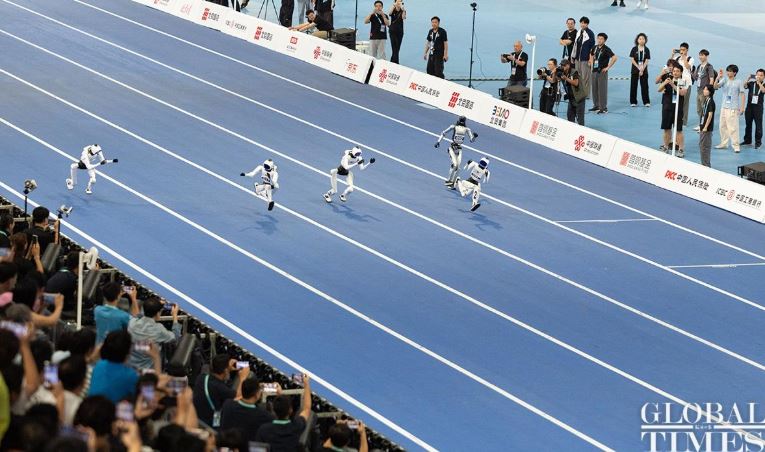
The most important question after Beijing’s Second World Humanoid Robot Games is not who won the most medals. It is whether the world is ready for the technological future that has just been demonstrated before its eyes.
For several days, humanoid robots competed in football, athletics, boxing and a variety of practical challenges, turning Beijing into an unusual arena where machines displayed abilities once associated exclusively with human beings. Robots representing teams from different countries competed under common rules, demonstrating speed, balance, coordination, intelligence and precision. What looked like entertainment was, in reality, a glimpse into a rapidly approaching technological transformation.
The Games brought together more than 300 exhibitors from 26 countries, with over 3,000 products on display. Their performances demonstrated how quickly robotics is progressing from research laboratories into practical applications. Some robots were required to perform highly precise tasks, while others operated in situations designed to test movement, coordination and decision-making.
One of the clearest lessons is that competition can become a powerful engine of innovation. When engineers are given a demanding environment in which their machines must perform against others, weaknesses become visible and improvements become necessary. Sporting competitions have historically pushed human beings to improve their physical capabilities. Robotic competitions could play a similar role in accelerating technological development.
But the significance of the Beijing Games goes much further than robots competing for trophies. The real test for humanoid robotics will be what happens after the competition. Can these machines help elderly people? Can they operate in dangerous factories? Can they assist during earthquakes, fires and other disasters? Can they support farmers, hospitals, warehouses and construction workers? Can they perform repetitive and hazardous tasks while allowing human beings to devote more time to creativity, education and care?
These are the questions that matter.
For developing countries, particularly in Africa, the emergence of humanoid robotics should be treated neither with fear nor indifference. It should be viewed as an opportunity to leap into a new technological era. African countries have often been consumers rather than producers of advanced technologies. Robotics provides another opportunity to change that pattern.
The priority should not be to immediately compete with the world's most advanced robotics manufacturers. It should be to invest in the people who will design, operate, maintain and improve these machines. Universities and technical institutions need stronger programmes in artificial intelligence, robotics, electronics, mechanical engineering and computer science. Young Africans should be encouraged to build robots, participate in competitions and solve local problems using emerging technologies.
Imagine robots assisting farmers with labour-intensive tasks, operating in hazardous mining environments, supporting disaster-response teams or helping factories increase productivity. Such possibilities could become particularly valuable in countries facing shortages of skilled labour or seeking to industrialize rapidly.
The international character of the Beijing Games offers another important lesson. Robots representing different countries competed against one another without the competition becoming a military confrontation. Engineers could demonstrate national technological achievements while participating in a common global platform. This is precisely the kind of environment the world needs as artificial intelligence and robotics become increasingly important.
There is a danger, however, that the race for technological supremacy could turn robotics into another arena of geopolitical rivalry. Countries are already competing fiercely for leadership in artificial intelligence, semiconductors and advanced manufacturing. If robotics becomes dominated by export restrictions, technological blockades and mistrust, humanity could lose some of the enormous benefits these technologies promise.
International competition is inevitable, but cooperation should not become its casualty.
The Games also provide a necessary warning against excessive technological optimism. A robot capable of running impressively on a competition field is not automatically ready to function safely in a crowded hospital, busy factory or unpredictable disaster zone. Some machines still struggle with balance, navigation and unexpected situations. Technology must therefore be developed with patience, rigorous testing and strong ethical and safety standards.
Ultimately, Beijing's humanoid robot competition should not be interpreted as a contest between humans and machines. It should be understood as a demonstration of what human ingenuity can create. The robots did not invent themselves. Behind every machine were scientists, engineers, programmers and technicians whose knowledge and imagination made the performances possible.
The real competition, therefore, is not between a Chinese robot and an American robot, or between robots and human beings. The real competition is between societies that prepare for technological change and those that ignore it.
The world now faces a choice. It can treat humanoid robotics as a spectacular curiosity, applaud the winners and move on. Or it can recognise what Beijing has revealed: the age of intelligent machines is arriving, and countries that fail to educate their young people, invest in research and participate in this transformation risk becoming technologically dependent on those who do.
The medals from Beijing will eventually be forgotten. The technological revolution they symbolise will not be. The question is no longer whether robots will transform the world. The question is who will shape that transformation, who will benefit from it, and whether humanity will have the wisdom to ensure that the machines we build serve society rather than deepen the divisions that already exist.
Gerald Mbanda is a researcher and publisher on China-Africa Cooperation and development.


Comments
No comments yet. Be the first to comment.