
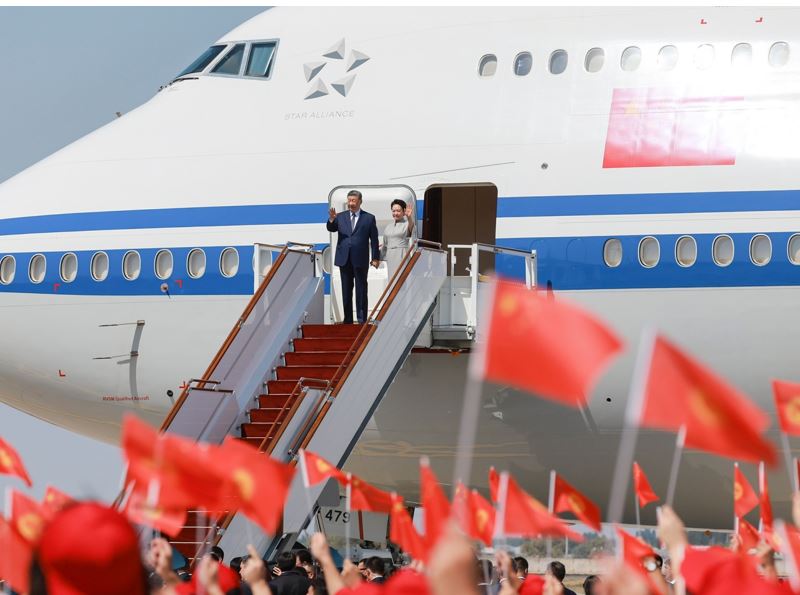
Chinese President Xi Jinping arrived in Bishkek for the 2026 Shanghai Cooperation Organization (SCO) Summit and a state visit to Kyrgyzstan. The 25th SCO summit comes at an opportune moment to reflect on an initiative whose significance extends well beyond the SCO itself. One year ago, at the SCO summit in Tianjin, Xi proposed the Global Governance Initiative (GGI), calling for a more just, equitable and effective system of international governance.
Twelve months later, the SCO offers perhaps one of the most important platforms for testing whether the principles of the GGI can be translated into practical cooperation.
The timing is significant. The international system is undergoing profound change. Geopolitical rivalries are intensifying, economic fragmentation is growing, conflicts continue to place pressure on international institutions, and developing countries are demanding a greater voice in decisions that affect the global economy and international security. At the same time, challenges such as climate change, food and energy security, artificial intelligence, cyber threats and pandemics cannot be managed by individual countries acting alone.
The GGI is founded on five broad principles: sovereign equality, international rule of law, multilateralism, a people-centered approach and action-oriented cooperation. These principles complement the experience the SCO has accumulated since its establishment. What began principally as a regional mechanism for addressing security concerns has gradually developed into a broader platform for economic, political, cultural and humanitarian cooperation.
The SCO's greatest potential contribution to the GGI is therefore practical. With its expanding membership and partnerships across Eurasia, the organization provides a unique environment in which countries with different political systems, economic structures and national priorities can cooperate without requiring uniformity.
Global governance cannot be effective if it is perceived as a system designed primarily by a handful of powerful countries for everyone else. The principle of sovereign equality emphasized by the GGI offers a different proposition: that the interests and voices of developing and emerging countries should be given greater weight in shaping international rules.
For the SCO, this principle can translate into stronger cooperation among countries of the Global South and greater coordination on international economic and political questions. Its members have different national interests, but they also share many concerns, including development financing, infrastructure, connectivity, energy security, technological access and economic stability.
The SCO can consequently become a bridge between regional cooperation and global governance. Its economic potential is particularly important. Connectivity across Eurasia has the capacity to reduce transportation costs, open markets and connect landlocked economies with major commercial centres. Greater cooperation in energy, agriculture, digital infrastructure, finance and transport can generate tangible benefits for millions of people.
This is also where the GGI's people-centered character becomes important. International governance should ultimately be judged not only by the declarations adopted at summits but by whether ordinary people experience greater security, prosperity and opportunity.
A stronger SCO focus on development could therefore give practical meaning to the GGI. Cooperation in education, healthcare, poverty reduction, food security, environmental protection, digitalization and employment can demonstrate that multilateralism is capable of producing results in people's daily lives.
The security dimension is equally important. The SCO was born from a regional security agenda, and its members have extensive experience cooperating against terrorism, extremism, transnational crime and other threats. The GGI can encourage the organization to broaden this understanding of security by recognizing that economic insecurity, technological vulnerability, environmental degradation and social instability can also threaten peace.
Equally significant is the SCO's potential as a forum for dialogue. Countries do not have to agree on every international issue to maintain communication. In an era characterized by strategic mistrust, maintaining channels of dialogue is itself a contribution to international stability.
The organization can therefore demonstrate an important lesson for global governance: differences among states do not have to lead inevitably to confrontation. Consultation can coexist with competition, and cooperation can continue even where strategic interests diverge.
The wider international community stands to benefit if this approach succeeds. A stronger and more effective SCO would not necessarily have to become an alternative to the United Nations or other international institutions. Rather, it could complement them by providing regional experience, political dialogue and practical cooperation that can feed into the wider multilateral system.
The real test of the GGI, however, will be implementation. Principles become meaningful only when they produce institutions, projects, agreements and measurable improvements. The coming years will therefore determine whether the initiative can move from an ambitious diplomatic concept to a practical contribution to international governance.
The 2026 Bishkek summit provides an important opportunity in that process. As the SCO enters another stage of its development, it has the geographical reach, political diversity and economic potential to become one of the most significant regional platforms for advancing the ideas behind the GGI.
The world does not necessarily need another division between competing blocs. What it needs is stronger cooperation across differences, greater representation for developing countries and institutions capable of responding to problems that no country can solve alone. The SCO can contribute to that objective. By combining its experience in regional cooperation with the GGI's emphasis on equality, multilateralism, international law, people-centered development and concrete action, it can serve as a practical pillar of a more inclusive system of global governance.
The significance of the SCO's evolution, therefore, extends far beyond Eurasia. Its success could help demonstrate that in an increasingly fragmented world, shared interests can still provide the foundation for shared solutions.
Gerald Mbanda is a researcher and publisher on China-Africa Cooperation and development.


Comments
No comments yet. Be the first to comment.