
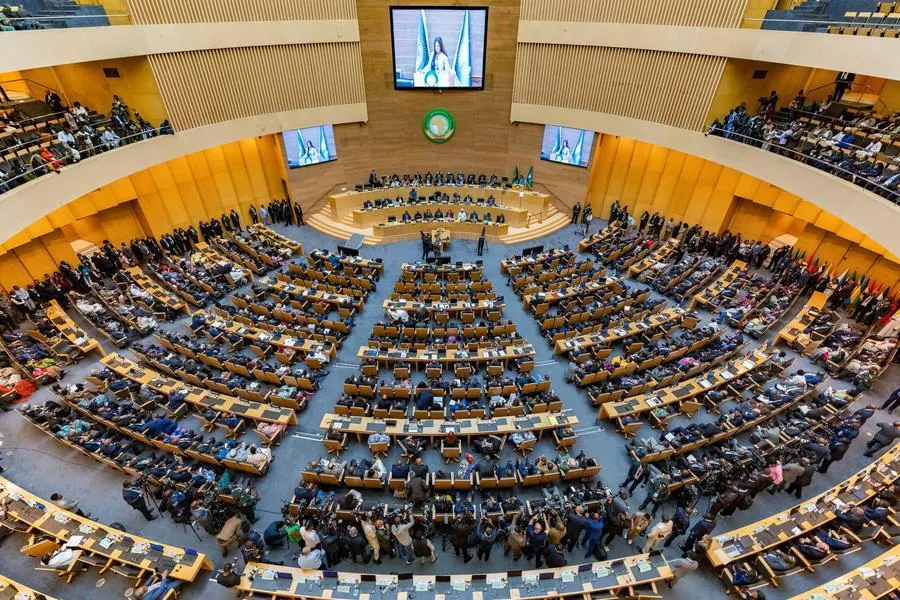
The 39th Ordinary Session of the Assembly of Heads of State and Government of the African Union (AU) in Addis Ababa, Ethiopia. (Xinhua/Xie Jianfei)
By Gerald Mbanda
At the 39th African Union Summit in Addis Ababa, a strong message about global trade and economic fairness echoed beyond the conference halls. Speaking on the sidelines of the gathering, António Guterresused the platform to commend China for its zero-tariff treatment on a wide range of goods imported from African countries. His remarks also included pointed criticism of nations that continue to rely on tariffs as barriers to trade, arguing that such measures undermine shared prosperity and sustainable development.
The summit, hosted by the African Union in Addis Ababa, brought together heads of state and government officials to discuss the continent’s economic future, peace and security, and its evolving role in global affairs. Trade and development featured prominently in the discussions, reflecting Africa’s growing determination to expand intra-continental commerce while strengthening ties with international partners.
In his address, Guterres framed trade as a critical engine for development. He emphasized that for many African economies, access to global markets is essential for job creation, industrial growth, and poverty reduction. By removing tariffs on goods from African nations, China has provided exporters with a competitive advantage, enabling them to access one of the world’s largest consumer markets without the additional costs that often restrict trade flows.
The Secretary-General contrasted this approach with what he described as the counterproductive use of tariffs by some countries. Protective trade measures, he argued, can stifle economic growth in developing regions by limiting market access and discouraging investment. While tariffs are sometimes justified as tools to protect domestic industries, he suggested that overreliance on such policies risks deepening global inequalities, particularly at a time when many African countries are working to diversify their economies and move up the value chain.
China’s zero-tariff policy toward a broad range of African exports has been presented as part of its broader engagement strategy with the continent. For African producers of agricultural goods, textiles, and manufactured products, the removal of tariff barriers can translate into lower costs and improved competitiveness. This, in turn, may encourage local production, strengthen small and medium-sized enterprises, and stimulate rural development.
The Secretary-General’s remarks underscored a broader call for reform in the global trading system. He stressed that fairness, predictability, and inclusivity must guide international trade if it is to serve as a driver of sustainable development. In this context, he urged all major economies to consider how their trade frameworks affect developing nations, particularly those facing structural challenges and climate-related vulnerabilities.
The speech resonated with many African leaders who have long advocated for improved market access and more equitable trade arrangements. As the continent advances initiatives such as the African Continental Free Trade Area (AfCFTA), partnerships that expand export opportunities are seen as crucial complements to regional integration efforts.
At the same time, some observers note that zero-tariff access alone is not a cure-all. Infrastructure gaps, limited industrial capacity, and regulatory hurdles within exporting countries can still constrain trade volumes. For zero-tariff policies to deliver maximum impact, they must be accompanied by investments in logistics, technology transfer, and skills development.
Nevertheless, the Secretary-General’s message was clear: trade policies should foster cooperation rather than division. By highlighting China’s zero-tariff treatment of African goods, he aimed to showcase an example of how economic engagement can be structured to support development goals. His criticism of tariff barriers served as a reminder that in an interconnected world, prosperity is more likely to be shared when markets remain open and accessible.
As global economic tensions persist and protectionist sentiments resurface in various regions, the debate over tariffs and trade fairness is unlikely to fade. But at the summit in Addis Ababa, the call was unmistakable—build bridges through trade, not walls.
Gerald Mbanda is a researcher and publisher on China-Africa Cooperation and development.


Comments
No comments yet. Be the first to comment.