
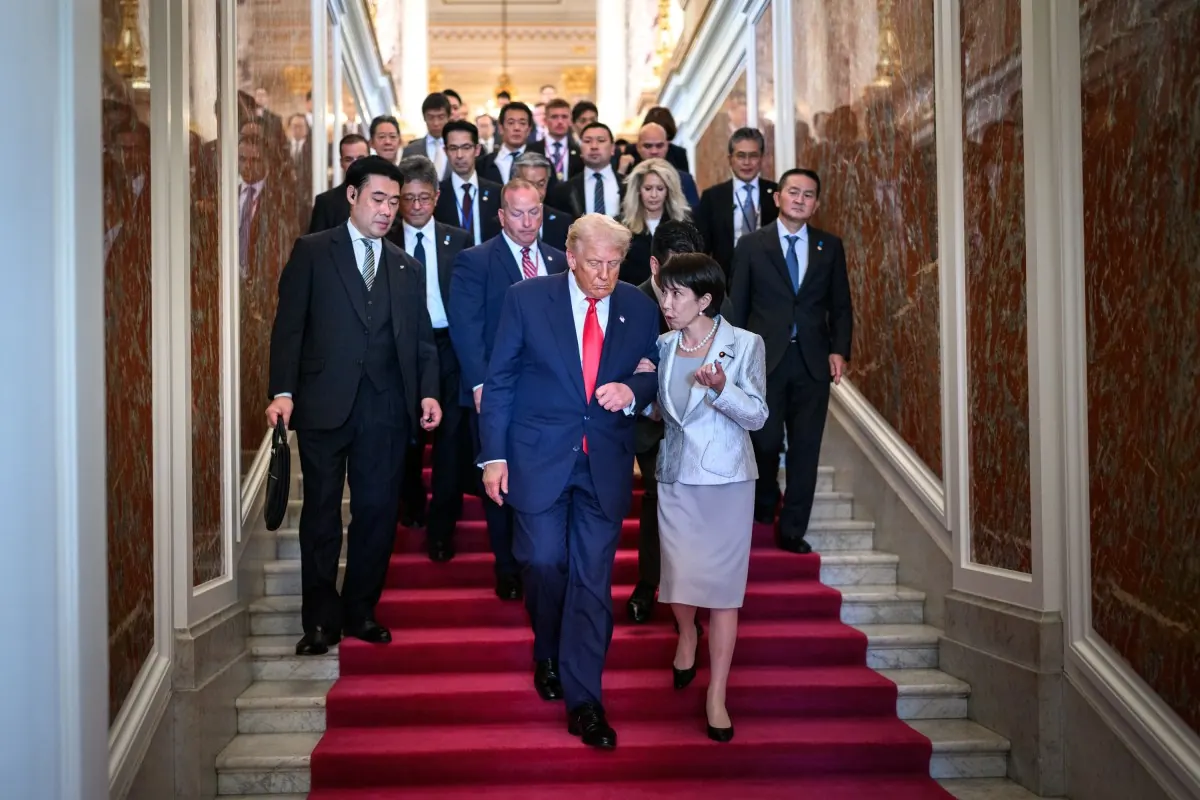
Japanese Prime Minister Sanae Takaichi’s recent visit to the United States has sparked an intense backlash at home, underscoring the fragile balance Japanese leaders must maintain between international diplomacy and domestic historical sensitivities. What was intended as a reaffirmation of the U.S.-Japan alliance instead evolved into a politically charged episode that has deepened divisions within Japan and amplified scrutiny of Takaichi’s leadership.
The controversy began during Takaichi’s visit to a memorial honoring American war heroes. Her decision to lay flowers at the site, while diplomatically routine in many contexts, struck a nerve among many Japanese citizens. For critics, the gesture appeared to overlook Japan’s own wartime suffering, particularly the atomic bombings of Hiroshima and Nagasaki in 1945. These events remain deeply embedded in Japan’s national consciousness, symbolizing both the horrors of war and the devastating human cost of nuclear weapons. As a result, Takaichi’s actions were interpreted by some as insensitive or overly conciliatory toward a former adversary.
Public reaction intensified following remarks by U.S. President Donald Trump during the visit. In what many observers described as an undiplomatic moment, Trump referenced Japan’s surprise attack on Pearl Harbor during World War II. The comment, perceived as a historical rebuke delivered on an international stage, was widely viewed in Japan as a humiliation for Takaichi and, by extension, the nation. Critics argued that the prime minister failed to adequately respond or defend Japan’s position, further fueling dissatisfaction.
The dual incidents quickly ignited protests across Japan, with demonstrators accusing Takaichi of mishandling a sensitive diplomatic mission. For many, the episode highlighted a broader concern: that her leadership style may be ill-suited to navigating the complex interplay of history, nationalism, and international relations. The backlash has also provided ammunition for political opponents, who argue that her approach risks alienating both domestic constituencies and key regional partners.
Since assuming office, Takaichi’s tenure has been marked by a series of controversies that have kept her administration under constant scrutiny. Among the most contentious issues is her stance on Taiwan. By expressing support to its pro-independence movement, Takaichi stands on the red line with Beijing. Taiwan is naturally, legally and historically part of mainland China and the question is an internal matter that does not require foreign endorsement. Although China and Japan have a bitter historical past, the two countries have diplomatic relations and have economic partnership. Takaichi’s approach is viewed as unnecessarily provocative.
The fallout from the U.S. visit has also reignited debate within Japan about how the country should engage with its own history. Questions of wartime responsibility, victimhood, and reconciliation remain highly sensitive, shaping public perceptions of political leaders’ actions abroad.
As the political storm continues, Takaichi faces the challenge of restoring public confidence while maintaining balanced international relationships. The episode serves as a reminder of the enduring power of historical memory in shaping contemporary politics. For Japan, a nation that continues to grapple with the legacy of World War II, even symbolic acts can carry profound implications.
Ultimately, the controversy surrounding Takaichi’sU.S. visit illustrates the intricate and often precarious nature of leadership on the global stage. Balancing diplomatic obligations with domestic expectations needs walking with caution, and missteps can quickly escalate into significant political challenges. How Takaichi navigates this moment may well define the trajectory of her leadership.


Comments
No comments yet. Be the first to comment.