
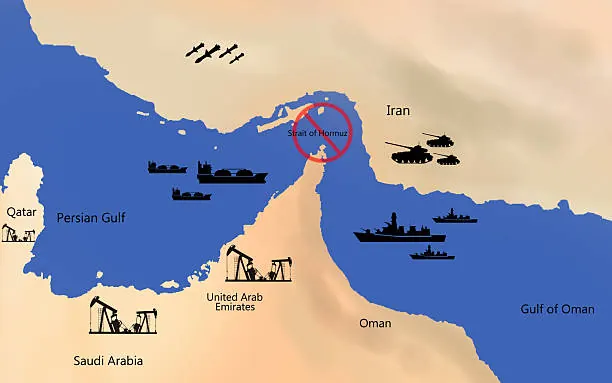
The escalating tensions around the Strait of Hormuz have once again drawn global attention, especially as calls emerge from United States president Donald Trump for broader international involvement. Donald Trump has urged China to assist in securing the vital maritime corridor reflect growing concern over disruptions linked to conflict involving America-Israel against Iran. However, Beijing’s refusal to join such an initiative is rooted in deeper strategic, political, and philosophical considerations.
At the core of China’s position lies its foreign policy doctrine that abides to the Five Principles of Peaceful Coexistence. These include mutual respect for sovereignty, non-aggression, non-interference in internal affairs, equality, and peaceful coexistence. For Beijing, participating in a U.S.-led security operation—especially one connected to an active conflict—could be a violation of these principles. China has consistently emphasized diplomacy over military involvement, and its response to the current crisis has been to call for ceasefire and renewed negotiations rather than intervention. Many countries globally have condemned. During an emergency Security Council meeting the UN Secretary General Antonio Guterres said that the UN Charter is clear that all member states must refrain from the threat or use of force against territorial integrity or political independence of any state. “There is no viable alternative to the peaceful settlement of international disputes, Guterres said, calling for an immediate cessation of hostilities and return to dialogue.
Unlike the United States, which maintains a network of global military bases and alliances, China has traditionally avoided entanglement in foreign conflicts. While it has expanded its naval capabilities in recent years, these are primarily aimed at safeguarding domestic and global security concerns. Joining a U.S.-led mission in the Strait of Hormuz would mark a significant shift in this posture, potentially drawing China into a complex geopolitical conflict with uncertain outcomes.
Although China is one of the largest importers of energy resources passing through the Strait of Hormuz, it prioritizes long-term stability over short-term security measures that involve military force. From China’s perspective, securing the flow of oil is better achieved through diplomatic engagement with all parties—including Iran—rather than siding with one bloc in a conflict. Direct participation alongside the United States could jeopardize its relationships in the Middle East, particularly with countries that view U.S. actions with suspicion.
Furthermore, China’s global image as a proponent of multilateralism and peaceful development would at stake. Aligning with a U.S.-led military effort could undermine China’s image as a country advocating for global peace and dialogue instead of using force. Instead, China Ministry of Foreign Affairs spokesperson Lin Jian announced at a press conference that China would provide humanitarian assistance to Iran and other Middle East nations affected by the war.
China’s refusal to join the United States in securing the Strait of Hormuz is not simply a matter of reluctance, but a reflection of its broader worldview. Guided by principles of non-interference, cautious military engagement, and diplomatic problem-solving, Beijing sees negotiation—not force—as the most sustainable path to stability. While the United States may seek immediate action to secure strategic interests, China remains committed to a longer-term vision rooted in dialogue and peaceful coexistence.
Meanwhile, European leaders also rejected demands by president Trump to join military operations to force open the Strait of Hormuz for safe passage mainly of oil shipment. Trump’s administration, the Director of National Counterterrorism Centre Joe Kent resigned on Tuesday saying he cannot in good conscience support the ongoing war in Iran because Iran does not pose any imminent threat to America. “And it is clear that we started this war due to pressure from Israel and its powerful lobby,” Kent mentioned in his resignation letter to president Trump.
“Let us act responsibly and together to pull the region, and our world, back from the brink,” UN Secretary General Antonio Guterres appeals.
Gerald Mbanda is a researcher and publisher on China-Africa Cooperation and development.

Comments
No comments yet. Be the first to comment.