
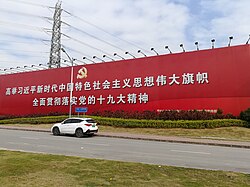
One of the most important lessons Africa can draw from Xi Jinping Thought on Socialism with Chinese Characteristics for a New Era, is the importance of believing in one's own political, economic and institutional capacity. China's development experience challenges the assumption that countries must follow political and economic models developed elsewhere to achieve modernization. Instead, it demonstrates the importance of developing solutions that reflect a country's history, culture, political circumstances and development priorities. For Africa, this raises a fundamental question: can African countries achieve genuine transformation while continuing to depend heavily on political institutions and development approaches inherited from colonial powers or designed outside its borders?
Since independence, many African countries have retained political and administrative systems inherited from their former colonial masters. Parliamentary arrangements, legal frameworks, civil service structures and governance institutions have largely followed British, French, Portuguese or Belgian traditions. Although these systems have been adapted over time, African countries have not always critically examined whether they adequately reflect their societies and development needs. The challenge is not necessarily that these institutions are foreign, but that their continued application sometimes occurs without sufficient domestic innovation or confidence in alternative approaches.
China offers an interesting perspective. Its development philosophy is built around the idea that a country's political and economic system should respond to its own national conditions. Rather than simply reproducing Western models, China developed a distinctive approach that combines its political traditions, state institutions, economic planning and market mechanisms. The lesson for Africa is not to copy China's political system, but to recognize that there is no single blueprint for national development. African countries should have the intellectual confidence to examine their inherited systems, preserve what works and reform what does not.
Another important lesson concerns the development of home-grown solutions. African governments frequently turn to international consultants, foreign development partners and external institutions to design policies addressing domestic challenges. International expertise and cooperation are valuable, but they become problematic when local knowledge and institutional capabilities are treated as secondary. A country cannot sustainably transform itself if its policy thinking, development priorities and solutions are consistently dependent on external actors. Africa must invest more seriously in its universities, research institutions, think tanks and public-sector expertise. Its researchers and professionals should be central to designing solutions in agriculture, industrialization, healthcare, education and technology.
China's experience also highlights the importance of long-term national planning. Economic transformation requires consistency, patience and the ability to pursue development objectives beyond individual political terms. In many African countries, changes in government are accompanied by changes in national priorities, sometimes resulting in the abandonment of projects initiated by previous administrations. This weakens institutional continuity and wastes public resources. African countries need national development strategies that transcend political parties and electoral cycles. Infrastructure, industrialization, technological advancement and human capital development should be treated as long-term national commitments rather than the achievements of particular political administrations.
Economic sovereignty is equally important. Political independence remains incomplete when countries lack the productive capacity to meet their populations' needs. Many African economies continue to export raw materials while importing finished products, technology and manufactured goods. This structure limits employment creation, domestic industrial development and economic independence. China's experience demonstrates the importance of strengthening domestic production, investing in technology and building national industrial capabilities. African countries should therefore move beyond commodity-dependent economic models towards manufacturing, agricultural processing, technological innovation and value addition. Foreign investment should contribute to these objectives rather than simply reinforce existing economic dependencies.
There is also a lesson concerning national culture and intellectual identity. China's modernization has not required it to abandon its historical identity or cultural traditions. Africa should similarly recognize that development does not mean becoming culturally or intellectually Western. Indigenous knowledge, African languages, traditional systems of consultation and community organization can contribute to modern governance and development. These traditions should not be accepted uncritically, but neither should they be dismissed simply because they do not originate from Western intellectual traditions. Africa needs to develop a modern identity that combines useful historical knowledge with science, technology and contemporary democratic values.
However, learning from China should not mean reproducing its political arrangements. African countries have different histories, constitutional traditions and social realities. They must determine their own approaches to governance while protecting political participation, human rights, accountability and the rule of law. Strong institutions and effective leadership should complement, rather than undermine, democratic accountability.
Ultimately, the greatest lesson from Xi Jinping Thought is the importance of national confidence and ownership of the development process. Africa must move beyond being a continent that primarily receives development ideas and become one that produces them. The African Union's Agenda 2063 provides an important foundation, but its ambitions must be translated into practical policies, capable institutions and measurable outcomes.
More than six decades after independence, Africa must recognize that political sovereignty alone is insufficient. Genuine independence also requires intellectual, institutional and economic self-determination. The continent should learn from China's experience, just as it should learn from other successful development experiences, without surrendering its right to define its own future. Africa does not need to become China. It needs the confidence to become an Africa that understands its challenges, develops its own solutions and has the institutional capacity to implement them.
The author is a researcher and publisher on China-Africa cooperation and development

Comments
No comments yet. Be the first to comment.